St. Andrew Community Refuge Plan
A community-centered approach to preparedness and stewardship.
1. Executive Summary
1.1 What This Document Is
This document provides a technical and operational analysis for religious institutions considering community refuge operations during hurricane events. Prepared by North Star Group as a systems integration framework, this analysis examines the intersection of structural engineering, emergency management protocols, operational logistics, and financial feasibility for church-based hurricane shelters.
The document synthesizes applicable building codes, FEMA guidance documents, emergency management best practices, and operational protocols to provide decision-makers with technically sound information. While engineering calculations and structural certifications must be performed by licensed professionals, this analysis provides the technical framework necessary for informed decision-making and professional coordination.
This resource addresses the growing interest among religious institutions in formal emergency shelter designation while providing realistic assessments of operational requirements, legal considerations, and financial implications. The analysis is structured to support both internal organizational planning and coordination with county emergency management agencies.
1.2 Why Churches Consider Refuge Operations
Religious institutions naturally serve as community gathering points during crisis events, with many congregants and community members instinctively viewing church facilities as places of stability and safety. This informal role creates both opportunities and responsibilities that organizations may choose to formalize through structured emergency shelter programs.
County emergency management agencies increasingly survey community facilities for potential shelter capacity as part of comprehensive disaster preparedness planning. According to FEMA's Community Emergency Response Team (CERT) guidelines, distributed shelter capacity reduces strain on centralized facilities and provides more accessible options for community members with transportation limitations or special needs.
The National Voluntary Organizations Active in Disasters (NVOAD) estimates that faith-based organizations provide approximately 80% of post-disaster recovery services, yet many lack formal integration with pre-disaster shelter planning. This represents both an opportunity for enhanced community resilience and a potential gap in emergency response coordination.
Recent hurricane events have demonstrated that informal shelter arrangements often emerge spontaneously during crisis periods. Formalizing these arrangements through proper planning, verification, and resource allocation can significantly improve outcomes for both shelter operators and those seeking refuge.
1.3 Operational Definition of "Refuge"
For the purposes of this analysis, "refuge" refers to time-limited emergency shelter operations providing basic life safety and support services during hurricane events. This differs significantly from both routine building occupancy and full-scale emergency shelters operated by governmental agencies.
Community refuge operations typically provide:
- Structural protection from wind and debris during hurricane passage
- Basic life support services including potable water, sanitation, and lighting
- Climate-controlled environment for extended occupancy periods
- Communication capabilities for emergency coordination and family contact
- Basic food service or food preparation capabilities
- Supervised environment with volunteer staff and basic security
The operational timeframe typically ranges from 24 to 72 hours, beginning before tropical storm-force winds arrive and continuing through initial post-storm assessment periods. This duration reflects the typical pattern of hurricane approach, passage, and immediate aftermath in Gulf Coast communities.
Refuge operations are distinguished from certified storm shelters by their focus on hurricane protection rather than tornado resistance. While both serve protective functions, the engineering requirements, operational protocols, and certification processes differ significantly. FEMA Publication 361, "Safe Rooms for Tornadoes and Hurricanes," provides detailed specifications for both types of facilities.
1.4 Key Organizational Decisions
Religious institutions considering refuge operations must address several fundamental questions that determine operational scope, resource requirements, and coordination obligations:
Population Scope: Organizations must define their target population, ranging from member-only arrangements to broader community access. This decision affects capacity planning, resource allocation, and coordination with county emergency management. The American Red Cross Shelter Operations Manual provides guidance on population assessment and intake procedures for different operational models.
Operational Duration: Refuge operations may be designed for short-term (24-36 hours), moderate-term (48-60 hours), or extended-term (72+ hours) events. Duration directly affects supply requirements, volunteer staffing needs, and infrastructure demands. FEMA's Mass Care Services guidance provides planning factors for different operational timeframes.
Responsibility Scope: Organizations must define their care obligations and operational boundaries. This includes decisions about medical support capabilities, pet accommodation policies, and specialized needs populations. The National Incident Management System (NIMS) provides frameworks for capability assessment and resource coordination.
Facility Modifications: Most existing religious facilities require some level of verification or modification for formal refuge designation. The International Building Code (IBC) provides baseline requirements for assembly occupancy, while ASCE 7 establishes wind load requirements for different risk categories.
Financial Commitment: Refuge operations involve both initial setup costs and ongoing operational expenses. Various federal, state, and local funding programs may offset these costs, but organizations must plan for financial sustainability independent of grant funding.
1.5 Technical and Operational Assessment
Modern religious facilities constructed under recent building codes generally provide a strong foundation for refuge operations, though formal verification and targeted improvements are typically required. Buildings constructed to International Building Code (IBC) 2012 or later incorporate enhanced wind resistance provisions and improved structural connectivity requirements compared to earlier code cycles.
Structural Considerations: Hurricane refuge operations primarily require verification of continuous load paths, roof-to-wall connections, and opening protection. The American Society of Civil Engineers (ASCE) Standard 7 provides wind load calculation methodologies, while FEMA P-55 addresses coastal construction requirements. Most structural modifications for refuge conversion involve connection reinforcement rather than major rebuilding projects.
Operational Complexity: Successful refuge operations require coordination across multiple functional areas including registration, logistics, food service, sanitation, medical support, pet accommodation, and volunteer management. The American Red Cross publishes comprehensive shelter management protocols that provide operational frameworks adaptable to smaller community-based facilities.
Regulatory Coordination: Formal refuge designation typically requires coordination with local emergency management agencies, building code officials, and fire departments. The Emergency Management Accreditation Program (EMAP) standards provide frameworks for capability assessment and documentation requirements.
Resource Requirements: Basic refuge operations require emergency power, water storage, sanitation supplies, communication equipment, and basic medical supplies. The Federal Emergency Management Agency publishes supply and equipment guidelines for different facility types and operational durations in FEMA Publication 476, "Floodplain Management Requirements."
Funding Opportunities: Multiple federal, state, and local programs provide funding for refuge-related improvements, including FEMA Hazard Mitigation Assistance programs, USDA Community Facilities programs, and state emergency management grants. However, funding is competitive and not guaranteed, requiring organizations to plan for alternative financing approaches.
References
American Red Cross. (2023). Shelter Operations Manual. Washington, DC: American Red Cross National Headquarters. Retrieved from https://www.redcross.org/get-help/disaster-relief-and-recovery-services/find-an-open-shelter
American Society of Civil Engineers. (2022). ASCE 7-22: Minimum Design Loads and Associated Criteria for Buildings and Other Structures. Reston, VA: ASCE Press. Retrieved from https://www.asce.org/publications-and-news/asce-7
Emergency Management Accreditation Program. (2023). EMAP Standards. Lexington, KY: EMAP Secretariat. Retrieved from https://www.emap.org/standards
Federal Emergency Management Agency. (2021). FEMA P-361: Safe Rooms for Tornadoes and Hurricanes. Washington, DC: FEMA. Retrieved from https://www.fema.gov/sites/default/files/2020-07/fema_safe-rooms-for-tornadoes-and-hurricanes_p-361.pdf
Federal Emergency Management Agency. (2019). Mass Care Services. Washington, DC: FEMA. Retrieved from https://www.fema.gov/emergency-managers/practitioners/mass-care
International Code Council. (2021). International Building Code. Country Club Hills, IL: International Code Council. Retrieved from https://www.iccsafe.org/products-and-services/i-codes/2021-i-codes/ibc/
National Voluntary Organizations Active in Disasters. (2023). NVOAD Member Services. Alexandria, VA: NVOAD. Retrieved from https://www.nvoad.org/member-services/
2. Understanding St. Andrew's Facility
2.1 Overview of the Campus
The St. Andrew By-The-Sea campus consists of three primary structures configured for worship, education, and fellowship activities. The facility layout, construction characteristics, and mechanical systems directly influence refuge capacity calculations, operational flow patterns, and structural verification requirements under hurricane loading conditions.
Campus circulation patterns affect emergency ingress, egress, and internal movement during extended occupancy periods. The International Building Code (IBC) Section 1006 establishes minimum egress requirements for assembly occupancies, while NFPA 101 Life Safety Code provides additional guidance for emergency evacuation and area of refuge designations.
Site topography, drainage patterns, and proximity to flood-prone areas influence facility suitability for refuge operations. FEMA flood maps and local drainage studies provide essential data for assessing flood risk during hurricane events when storm surge and inland flooding commonly occur simultaneously.
2.2 What Buildings Exist Today
2.2.1 Sanctuary
The sanctuary represents a large-volume assembly space with minimal interior structural support elements, creating specific wind load distribution patterns and structural behavior characteristics. Such configurations are classified as "low-rise buildings" under ASCE 7-22 wind load provisions, with specific pressure coefficient applications for large roof areas.
High-volume spaces experience different internal pressure dynamics compared to compartmentalized areas when exterior envelope failures occur. ASCE 7-22 Section 26.13 provides internal pressure coefficient calculations for buildings with varying opening configurations and sizes.
Potential refuge applications include pre-storm assembly areas, community meeting spaces during extended events, and overflow sleeping capacity. However, large-span roof structures require specific engineering verification for refuge occupancy loads, particularly during peak wind events when additional structural stresses occur.
2.2.2 Fellowship/Education Building
Multi-room educational facilities provide optimal configurations for refuge operations due to compartmentalized layouts, distributed mechanical systems, and flexible space allocation capabilities. These characteristics align with American Red Cross shelter management protocols emphasizing privacy, noise control, and functional separation.
Kitchen facilities enable food service operations ranging from simple reheating to full meal preparation. NSF International provides commercial kitchen equipment standards, while local health departments establish operational requirements for temporary food service in emergency shelters.
Classroom spaces accommodate family units, special needs populations, and functional activities including registration, medical triage, and volunteer coordination. The Federal Emergency Management Agency recommends 20-40 square feet per person for sleeping areas, with additional space allocations for circulation, storage, and support functions.
2.2.3 Offices, Hallways, Auxiliary Spaces
Support spaces house critical building systems including electrical panels, communication equipment, mechanical rooms, and emergency supply storage. During refuge operations, these areas require controlled access to maintain operational security and prevent unauthorized system modifications.
Interior corridors without exterior openings often provide the safest refuge areas during peak wind conditions. FEMA P-361 identifies interior rooms, corridors, and closets on the lowest floor as preferred safe areas in buildings not specifically designed as storm shelters.
Mechanical and electrical rooms require access for maintenance and system monitoring during extended operations. The National Electrical Code (NEC) Article 110 establishes working space requirements around electrical equipment that must be maintained during refuge operations.
2.3 How the Buildings Were Built (2010 / 2018 remodel)
Construction under International Building Code (IBC) 2009/2012 cycles incorporated enhanced wind resistance provisions compared to earlier code editions. Key improvements include strengthened roof-to-wall connections, upgraded door and window performance requirements, and enhanced structural connection details.
The 2018 renovation likely updated mechanical, electrical, and plumbing systems to current code requirements while potentially improving envelope performance and energy efficiency. However, structural modifications during renovation may have created discontinuities in load paths requiring engineering verification.
Documentation of as-built conditions and renovation details is essential for engineering assessment. Typical documentation includes architectural drawings, structural plans, mechanical/electrical schematics, and inspection reports from permitting authorities. The American Institute of Architects (AIA) Document G704 provides standard formats for construction documentation.
Wind speed requirements for the Gulf Shores area under IBC 2012 provisions range from 140-150 mph ultimate design wind speeds (3-second gust), depending on risk category and exposure conditions. ASCE 7-10, referenced by IBC 2012, provides wind speed maps and calculation procedures for determining site-specific design pressures.
2.4 What "High Partition" Means in Plain Language
"High partition" refers to interior wall configurations that do not provide continuous structural bracing for roof systems under lateral loading. In sanctuary-type spaces, roof structures must transfer wind forces directly to exterior walls and foundation systems without intermediate support from interior partitions.
This configuration creates specific structural load paths and potential failure modes that engineers evaluate during refuge verification assessments. ASCE 7-22 Chapter 27 provides analytical procedures for determining wind loads on structural elements in buildings with various interior configurations.
Large unobstructed interior volumes may experience wind-induced pressure fluctuations different from those in compartmentalized spaces. These dynamic effects influence structural response and occupant comfort during high-wind events. Wind tunnel testing data, compiled in ASCE 7-22 Chapter 31, provides pressure coefficients for various building configurations and opening arrangements.
2.5 Initial Building Strength: What We Think We Know
Modern construction typically incorporates continuous load paths, adequate connection details, and appropriate materials for design wind loads. However, refuge operations may exceed standard occupancy assumptions, particularly regarding internal pressure loads and dynamic effects during sustained high winds.
Visual indicators of structural adequacy include properly attached roof sheathing, continuous wall framing, adequate foundation connections, and undamaged exterior envelope components. However, connection details and load path continuity require professional engineering verification through drawings review and field inspection.
Building performance during previous storm events provides valuable data for assessment. Post-storm damage assessments, insurance claims, and repair records indicate areas of vulnerability or confirm adequate performance under actual loading conditions.
2.6 What Needs Verification by Baldwin County / Engineer
Structural engineering assessment typically examines load path continuity, connection adequacy, and envelope performance under design wind loads. The International Building Code Section 1609 establishes minimum wind load requirements, while local amendments may impose additional requirements based on regional hazard characteristics.
Key verification areas include:
- Roof System Analysis: Connection details, uplift resistance, and diaphragm continuity per ASCE 7-22 wind load provisions
- Wall Anchorage: Foundation connections, stud-to-plate attachments, and shear wall configurations per IBC Section 2308
- Opening Protection: Door and window anchorage, impact resistance, and pressure rating verification per IBC Section 1609
- Internal Refuge Areas: Identification of safest interior zones during peak wind conditions per FEMA P-361 guidance
- Mechanical Systems: HVAC performance, emergency power requirements, and life safety system functionality per IMC and NFPA standards
County building departments typically require stamped engineering assessments for formal refuge designation. The Alabama State Board of Licensure for Professional Engineers requires structural assessments to be prepared by licensed professional engineers for life safety applications.
Engineering documentation should include structural calculations, annotated drawings showing critical connections, and recommendations for any required improvements. The Structural Engineering Institute (SEI) of ASCE provides guidelines for structural condition assessments and renovation projects.
References
Alabama State Board of Licensure for Professional Engineers and Land Surveyors. (2023). Engineering Practice Guidelines. Montgomery, AL: BELS. Retrieved from https://bels.alabama.gov/engineering/
American Institute of Architects. (2023). AIA Contract Documents. Washington, DC: AIA. Retrieved from https://www.aia.org/contract-documents
American Society of Civil Engineers. (2022). ASCE 7-22: Minimum Design Loads and Associated Criteria for Buildings and Other Structures. Reston, VA: ASCE Press.
Federal Emergency Management Agency. (2021). FEMA P-361: Safe Rooms for Tornadoes and Hurricanes. Washington, DC: FEMA.
International Code Council. (2021). International Building Code. Country Club Hills, IL: ICC.
International Code Council. (2021). International Mechanical Code. Country Club Hills, IL: ICC. Retrieved from https://www.iccsafe.org/products-and-services/i-codes/2021-i-codes/imc/
National Fire Protection Association. (2021). NFPA 101: Life Safety Code. Quincy, MA: NFPA. Retrieved from https://www.nfpa.org/codes-and-standards/all-codes-and-standards/list-of-codes-and-standards/detail?code=101
NSF International. (2023). Commercial Kitchen Equipment Standards. Ann Arbor, MI: NSF. Retrieved from https://www.nsf.org/testing-services/by-industry/food-equipment-safety/commercial-food-equipment
3. Understanding the Hazards
3.1 Tornado vs. Hurricane: Why They Are Different
Tornado and hurricane events require fundamentally different structural design approaches due to distinct wind characteristics, duration patterns, and associated hazards. Understanding these differences is crucial for appropriate facility assessment and refuge planning.
Tornadoes generate extreme wind speeds (200-300+ mph) over narrow paths and brief durations, typically lasting minutes. The Enhanced Fujita Scale, used by the National Weather Service, categorizes tornado intensity based on damage indicators, with EF4-EF5 events producing winds exceeding 200 mph. FEMA P-361 establishes design criteria for tornado safe rooms requiring resistance to 250 mph winds and debris impact from 2x4 lumber traveling at 100 mph.
Hurricanes affect large geographic areas with sustained winds and pressure differentials over extended periods. The Saffir-Simpson Hurricane Wind Scale categorizes hurricane intensity from Category 1 (74-95 mph) to Category 5 (157+ mph sustained winds). Hurricane wind fields extend hundreds of miles from the storm center, with tropical storm-force winds (39+ mph) often persisting for 12-24 hours or more.
Structural loading patterns differ significantly between the two hazards. Tornado loading involves extreme peak pressures and rapid pressure changes that can cause building envelope failure and internal pressurization. Hurricane loading involves sustained pressure applications over extended periods that test structural endurance and fatigue resistance rather than peak strength alone.
3.2 Tornado Requirements "Tornado Safe Room"
Emergency management agencies often use familiar terminology when discussing shelter capabilities, and "tornado safe room" has specific meanings in federal guidance documents. However, the requirements for tornado safe rooms far exceed those necessary for hurricane refuge operations in coastal Alabama.
FEMA P-361 defines tornado safe rooms as hardened structures designed to provide "near-absolute protection" from EF5 tornadoes. These facilities require:
- Structural design for 250 mph wind loads with impact resistance
- Continuous reinforced concrete or steel construction
- Impact-rated doors and no windows
- Independent life safety systems
- Professional engineering certification
Such facilities cost $300-600 per square foot for new construction and require extensive modifications to existing buildings. The ICC-500 Standard provides technical requirements for storm shelters, while FEMA maintains a registry of tested and approved shelter products.
3.3 Why Hurricanes Are the Primary Threat Here
Gulf Shores faces hurricane threats as the primary wind hazard requiring evacuation or shelter decisions. National Hurricane Center historical data shows the Alabama coast experiences hurricane-force winds approximately every 7-10 years, with major hurricanes (Category 3+) occurring roughly every 15-20 years.
Hurricane Ivan (2004) produced sustained winds of 105 mph in Baldwin County with gusts to 135 mph. Hurricane Sally (2020) generated sustained winds of 85-100 mph with extensive flooding. These events demonstrate the typical wind speeds and duration patterns that refuge facilities must accommodate.
Tornado events in coastal Alabama are typically associated with tropical systems and produce lower intensity ratings (EF0-EF2) compared to tornado alley regions. The Storm Prediction Center's tornado climatology shows Baldwin County averages less than one tornado per year, with most events producing winds below 150 mph.
Hurricane planning addresses the most statistically likely scenario requiring community refuge operations: sustained winds, extended power outages, and transportation disruptions affecting normal residential occupancy patterns. This focus allows for practical and cost-effective facility improvements rather than extreme hardening measures.
3.4 What Happens in a Major Hurricane (for the people inside)
Hurricane refuge operations typically span 48-72 hours and follow predictable phases that affect facility requirements, operational protocols, and resource consumption patterns. Understanding these phases enables appropriate planning and resource allocation.
Pre-landfall Phase (12-24 hours): Participants arrive with personal belongings, complete registration processes, and settle into assigned areas. Wind speeds gradually increase from normal conditions to tropical storm force (39+ mph). Facility preparation includes securing exterior objects, testing emergency systems, and completing final supply inventories.
Impact Phase (6-12 hours): Hurricane-force winds (74+ mph) make outdoor movement dangerous. Participants remain indoors in designated areas while facility experiences peak structural loading. Power outages commonly occur during this phase, requiring backup lighting and communication systems. Wind noise and building movement may cause anxiety among participants.
Extended Event Phase (24-48 hours): Storm passage involves fluctuating conditions as outer bands and eye wall pass over the facility. Participants experience confinement stress while facility systems operate under emergency conditions. Food service, sanitation, and climate control become increasingly important for maintaining acceptable conditions.
Recovery Phase (12-24 hours): Wind speeds decrease to safe levels for exterior movement and damage assessment. Participants prepare to return home while facility operators assess building condition and coordinate with emergency services. Road clearance and utility restoration determine departure timing.
3.5 What Failure Looks Like (roof loss, debris, water)
Understanding potential failure modes enables realistic risk assessment and targeted mitigation measures. Hurricane building failures typically follow predictable patterns related to wind pressure distribution, structural load paths, and envelope vulnerability.
Roof System Failure: Wind uplift forces concentrate at roof edges and corners where pressure coefficients reach -3.0 or higher per ASCE 7-22. Inadequate connections between roof sheathing, framing, and walls can lead to progressive failure starting at roof perimeters. The Insurance Institute for Business & Home Safety (IBHS) research demonstrates that roof edge securement is critical for overall system performance.
Opening Failures: Windows and doors represent the most vulnerable envelope components due to concentrated load applications and dynamic pressure effects. Large opening failures can rapidly increase internal pressure, accelerating structural damage. The American Architectural Manufacturers Association (AAMA) provides performance standards for fenestration products under hurricane conditions.
Water Intrusion: Hurricane rainfall rates commonly exceed 1-2 inches per hour while wind-driven rain penetrates normally weatherproof assemblies. Roof drainage systems may become overwhelmed, causing ponding and additional structural loading. The National Roofing Contractors Association (NRCA) provides guidelines for hurricane-resistant roofing systems and drainage design.
Progressive Collapse: Initial failures in critical structural elements can propagate throughout building systems. Loss of lateral bracing, diaphragm continuity, or load-bearing elements may compromise overall structural stability. ASCE 41 provides analytical procedures for assessing progressive collapse vulnerability.
3.6 Realistic Goal: "Keep the Roof On and Keep People Safe"
Effective hurricane refuge design focuses on maintaining structural envelope integrity and occupant protection during design wind events rather than preventing all possible damage. This approach balances protection levels with practical implementation costs and existing building constraints.
Primary objectives include:
- Load Path Continuity: Ensuring wind forces transfer from roof systems through wall framing to foundation elements without failure or discontinuity
- Envelope Integrity: Maintaining roof covering, wall cladding, and opening protection to prevent water intrusion and internal pressurization
- Safe Areas: Identifying interior spaces with maximum protection from potential debris and structural failure during peak wind conditions
- Life Safety Systems: Maintaining emergency lighting, communication, ventilation, and egress capabilities throughout the event duration
These objectives align with FEMA's "Wind-Resistant Construction" guidelines emphasizing practical improvements that provide significant risk reduction without requiring complete rebuilding. The Federal Alliance for Safe Homes (FLASH) promotes similar approaches through their "Strengthen Your Home" program.
Success metrics focus on maintaining habitability and safety rather than preventing all damage. Post-storm assessments should find minimal water intrusion, no structural damage in occupied areas, and full functionality of life safety systems throughout the event period.
References
American Architectural Manufacturers Association. (2023). AAMA 501.6-18: Voluntary Test Method for Hurricane Impact and Cyclic Wind Pressure Resistance. Schaumburg, IL: AAMA. Retrieved from https://www.aamanet.org/general.asp?sect=3&id=127
American Society of Civil Engineers. (2017). ASCE 41-17: Seismic Evaluation and Retrofit of Existing Buildings. Reston, VA: ASCE Press.
Federal Alliance for Safe Homes. (2023). Strengthen Your Home Program. Tallahassee, FL: FLASH. Retrieved from https://flash.org/strengthen-your-home/
Federal Emergency Management Agency. (2019). Wind-Resistant Construction Guidelines. Washington, DC: FEMA. Retrieved from https://www.fema.gov/emergency-managers/risk-management/building-science
Insurance Institute for Business & Home Safety. (2023). Hurricane Research. Richburg, SC: IBHS. Retrieved from https://ibhs.org/risk-research/hurricane/
National Hurricane Center. (2023). Historical Hurricane Database. Miami, FL: NHC. Retrieved from https://www.nhc.noaa.gov/data/hurdat/
National Roofing Contractors Association. (2023). Hurricane Preparedness Guidelines. Rosemont, IL: NRCA. Retrieved from https://www.nrca.net/resources/public/hurricane-preparedness
Storm Prediction Center. (2023). Tornado Climatology. Norman, OK: SPC. Retrieved from https://www.spc.noaa.gov/climo/
4. Occupancy
Occupancy describes who is present during a refuge activation, how many people can reasonably be inside, and for how long the facility can support them. These questions shape later planning but do not assume any particular model or obligation.
4.1 Possible Occupancy Patterns
Several basic occupancy patterns are possible in a small refuge setting. Examples include:
- Access limited to church members and their households
- A pre-identified list of people who face difficulty evacuating or sheltering safely at home
- Access based on proximity to the church (nearby neighbors)
- First-come, first-served access during a defined activation period
- Lists or criteria developed in conversation with local emergency officials
These patterns are presented as conceptual options only. Any specific approach would be defined locally.
4.2 Example Occupancy Concept for St. Andrew
For a town the size of Gulf Shores and a facility with limited physical capacity, one example occupancy concept focuses on people who are unsafe at home during a storm but do not require hospital care. An example configuration might emphasize:
- Older adults or people with mobility limitations who cannot easily evacuate
- Residents living in manufactured homes or older structures that are not built to current wind-resistance standards
- Individuals without reliable transportation who would otherwise remain in harm’s way
- Medically stable individuals whose health would be at risk in a prolonged outage or high-wind event but who do not need intensive medical treatment
- Small pets accompanying their owners, managed in a simple, contained way
In this example, occupancy planning might include a call list developed in calm conditions and potential use of a church van to bring identified individuals to the building before conditions deteriorate. This is one possible way to think about occupancy in a small facility; other arrangements are also possible.
4.3 Capacity Factors
The number of people who can be inside the building during refuge operations depends on several factors rather than a single number.
Life-Safety Occupancy:
- The International Building Code (IBC) provides baseline occupant loads for assembly spaces, often in the range of 7–15 square feet per person for seated use.
- These calculations are intended for normal gatherings, not for sleeping or prolonged stay.
Refuge and Sleeping Space:
- Emergency shelter planning guidance often uses 40–60 square feet per person as a planning range when people are sleeping on the floor with personal belongings and circulation space.
- Actual planning can consider not only the sanctuary but also halls, classrooms, or other rooms that could be used during activation.
Restrooms and Sanitation:
- Restroom capacity and cleaning effort can become a limiting factor, especially if occupancy continues beyond a single night.
- The International Plumbing Code (IPC) is commonly used as a reference for minimum fixture counts in assembly occupancies.
Ventilation and Temperature Control:
- Ventilation needs increase with the number of people and the length of stay.
- ASHRAE Standard 62.1 provides general guidance on indoor air quality that can inform discussions about generator sizing, fresh air, and comfort.
Practical Oversight:
- The number of people that can be safely and calmly supported also depends on how many volunteers are present to monitor conditions, assist participants, and handle routine issues.
4.4 Duration of Stay
Occupancy planning is tied to how long people may remain in the building during a typical activation. Common planning horizons include:
Up to 24 Hours:
- Used mainly for storm passage or short outages
- Participants may bring their own essential items
- Demands on supplies and building systems remain relatively light
24–48 Hours:
- Requires more deliberate attention to water, snacks or simple food, and restroom cycles
- Temperature control and ventilation become more important to maintain comfort and safety
72 Hours and Beyond:
- Involves careful planning for generator fuel, basic comfort heating or cooling, and simple medical support arrangements
- Volunteer rotation and cleaning routines become more structured
National training materials from organizations such as the American Red Cross use similar time brackets to illustrate how resource needs change as duration increases.
4.5 Volunteer Considerations
Supporting any occupancy model involves work from staff and volunteers. Typical considerations include:
- Moving chairs and furniture to create sleeping areas
- Basic intake or check-in processes when people arrive
- General observation of the space and responding to routine needs
- Fatigue, especially when volunteers also have homes or family members affected by the same storm
National Voluntary Organizations Active in Disaster (NVOAD) and American Red Cross documents describe simple role definitions and shift concepts that can be adapted to small sites.
4.6 Facility Impact
Refuge use concentrates people, equipment, and activity into a short period of time. Examples of facility impacts include:
- Increased wear on restrooms and high-traffic flooring
- Need for post-event cleaning and minor repairs
- Temporary interruption or relocation of routine church activities
Facility management references, including guidance from the International Facility Management Association (IFMA), offer general approaches for planning short-duration, high-intensity use of buildings.
References
American Red Cross. (2023). Shelter Fundamentals; Shelter Simulation Exercise. Retrieved from https://www.redcross.org/
Centers for Disease Control and Prevention. (2023). Emergency Sheltering Guidelines. Atlanta, GA: CDC.
Federal Emergency Management Agency. (2023). Mass Care/Emergency Assistance Program Guidance. Washington, DC: FEMA.
International Code Council. (2021). International Building Code; International Plumbing Code. Washington, DC: ICC.
American Society of Heating, Refrigerating and Air-Conditioning Engineers. (2022). ASHRAE Standard 62.1: Ventilation for Acceptable Indoor Air Quality. Atlanta, GA: ASHRAE.
National Voluntary Organizations Active in Disaster. (2023). Sheltering and Volunteer Management Resources. Washington, DC: NVOAD.
International Facility Management Association. (2023). Facility Impact Assessment Guidelines. Houston, TX: IFMA.
5. Refuge Planning for Real People
5.1 Who Actually Comes During a Storm?
Storm refuge facilities typically serve diverse demographic groups with varying needs, capabilities, and support requirements. Understanding these population characteristics enables appropriate facility planning, volunteer training, and resource allocation.
5.1.1 Families
Family units with children represent the largest demographic in community refuges, requiring space configurations that accommodate group sleeping, supervised activity areas, and noise management protocols. The Federal Emergency Management Agency's Mass Care Services guidelines recommend family cluster arrangements to maintain social cohesion while providing appropriate supervision.
Children experience stress responses to confinement, unfamiliar environments, and disrupted routines. The National Child Traumatic Stress Network provides guidance on supporting children in emergency shelter environments, emphasizing structured activities, predictable schedules, and adult reassurance.
Space requirements for families include private sleeping areas, secure storage for personal belongings, and designated activity zones. The American Red Cross recommends 40-50 square feet per person for family sleeping areas with additional common space for meals and recreation.
5.1.2 Elderly
Senior participants often present multiple challenges including mobility limitations, chronic medical conditions, sensory impairments, and social isolation issues. The Administration for Community Living provides guidelines for emergency planning for older adults emphasizing environmental modifications and support services.
Physical accessibility requirements include proximity to restroom facilities, minimize stair usage, adequate lighting, and temperature control. The Americans with Disabilities Act (ADA) Accessibility Guidelines establish minimum standards for accessible routes, doorway widths, and fixture placement.
Medical considerations include medication management, mobility device accommodation, and potential need for assistance with activities of daily living. The Centers for Disease Control and Prevention (CDC) provides guidance on medication safety in congregate care settings.
5.1.3 Disabled
Individuals with physical, sensory, or cognitive disabilities require specific accommodations and support protocols. The National Organization on Disability provides emergency preparedness guidelines emphasizing advance planning, assistive technology accommodation, and communication accessibility.
Physical accommodations include wheelchair accessible entrances, adapted restroom facilities, accessible sleeping areas, and clear circulation paths. The International Code Council's ICC A117.1 Standard provides technical requirements for accessible design in various building types.
Communication accommodations may include sign language interpretation, large print materials, and assistive listening devices. The Federal Communications Commission (FCC) provides guidelines for emergency communication accessibility during disaster events.
5.1.4 Medically Fragile
Participants requiring powered medical equipment, refrigerated medications, or regular monitoring present significant challenges for community-level refuges. The Department of Health and Human Services maintains registries of special needs populations requiring enhanced support during emergencies.
Power-dependent medical equipment includes oxygen concentrators, CPAP machines, ventilators, and mobility aids. Backup power planning must accommodate these loads while maintaining equipment reliability and safety standards per National Electrical Code (NEC) Article 517 healthcare facility requirements.
Medication storage requires temperature control, security, and proper labeling. The U.S. Pharmacopeial Convention provides guidelines for medication storage in emergency situations, emphasizing cold chain maintenance and contamination prevention.
5.1.5 People Who Are Afraid
Many refuge participants seek primarily emotional security and social support rather than protection from specific physical vulnerabilities. The substance Abuse and Mental Health Services Administration (SAMHSA) provides guidance on psychological support in emergency shelters emphasizing reassurance, information sharing, and social connection.
Anxiety management techniques include clear communication about facility safety, regular updates on external conditions, and organized group activities. The American Psychological Association provides disaster mental health guidelines for non-professional support personnel.
5.2 What They Bring
Effective refuge operations establish clear guidelines for participant supply responsibilities while maintaining backup resources for unprepared individuals. Supply management affects operational efficiency, volunteer workload, and facility safety.
5.2.1 Medication
Participants should bring minimum 72-hour medication supplies in original containers with clear labeling and dosage instructions. The Institute for Safe Medication Practices provides guidelines for medication management in emergency situations emphasizing patient responsibility and professional oversight.
Controlled substances require special handling protocols to prevent diversion while ensuring participant access. The Drug Enforcement Administration provides guidance on controlled substance security during emergency operations.
Refrigerated medications present storage challenges requiring temperature monitoring and backup power planning. The United States Pharmacopeial Convention establishes storage standards for temperature-sensitive medications in emergency situations.
5.2.2 Phone Chargers
Personal communication devices enable family contact and emergency information access throughout refuge operations. The Federal Communications Commission emphasizes communication resilience as a critical element of emergency preparedness.
Charging infrastructure planning should accommodate diverse device types while managing electrical loads under emergency power conditions. Common charging stations reduce individual outlet requirements while enabling volunteer supervision of electrical usage.
5.2.3 Blankets / Bedding
Personal bedding improves comfort and reduces facility supply requirements while addressing individual preferences and hygiene concerns. The American Red Cross recommends participant-provided bedding as standard practice for community shelter operations.
Backup bedding supplies should accommodate 10-15% of anticipated capacity for unprepared participants or bedding failures. Storage requirements include protection from moisture, insects, and contamination between events.
5.2.4 Pets and Carriers
Pet accommodation significantly affects evacuation decisions and refuge participation rates. The Pet Evacuation and Transportation Standards (PETS) Act requires state and local emergency plans to account for pets and service animals in evacuation planning.
Pet supply requirements include carriers, restraints, food, water, medications, and waste management materials. The American Veterinary Medical Association provides guidelines for pet care in emergency shelter environments.
5.3 What Cannot Come
Clear prohibited item policies protect participant safety, facility security, and operational efficiency. Policy enforcement requires volunteer training and consistent application during high-stress intake periods.
Weapons and Contraband: Firearms, weapons, and illegal substances represent obvious safety hazards requiring clear policies and enforcement procedures. State concealed carry laws may affect weapon policies, requiring legal consultation and coordination with law enforcement.
Hazardous Materials: Flammable liquids, propane tanks, generators, and chemical products present fire and health hazards inappropriate for indoor storage. The Occupational Safety and Health Administration (OSHA) provides guidelines for hazardous material identification and safe storage practices.
Large Appliances: Personal refrigerators, space heaters, and high-power electrical devices may overload facility electrical systems and create safety hazards. The National Fire Protection Association (NFPA) 1 Fire Code addresses electrical load management and fire prevention in assembly occupancies.
5.4 Behavior and Stress Management
Extended confinement in crowded conditions creates stress requiring proactive management through environmental design, activity programming, and clear behavioral expectations.
Noise Control: Sound management includes designated quiet hours, activity zone separation, and clear expectations for conversation volume and music. The American Academy of Audiology provides guidelines for noise management in congregate living environments.
Privacy Management: Visual and acoustic privacy improve participant comfort and reduce stress levels. Portable screens, furniture arrangement, and activity scheduling can provide privacy without permanent modifications.
Conflict Resolution: Trained volunteers should be prepared to mediate disputes, enforce behavioral standards, and de-escalate tensions. The American Red Cross provides conflict resolution training specifically designed for shelter operations.
5.5 Privacy, Dignity, and Safety Inside the Building
Maintaining human dignity under emergency conditions requires attention to privacy, personal space, and cultural sensitivities while working within facility constraints and resource limitations.
Sleeping Arrangements: Family clusters, gender-separated areas, and individual space allocation help maintain dignity and reduce stress. The United Nations High Commissioner for Refugees provides shelter design guidelines emphasizing dignity and cultural appropriateness.
Personal Hygiene: Access to soap, towels, and privacy for personal care maintains health and dignity. The Centers for Disease Control and Prevention provides guidelines for hygiene maintenance in congregate care settings.
Cultural Sensitivity: Religious practices, dietary restrictions, and cultural customs require accommodation within operational constraints. The National Voluntary Organizations Active in Disasters provides cultural competency training for disaster relief operations.
References
Administration for Community Living. (2023). Emergency Planning for Older Adults. Washington, DC: ACL. Retrieved from https://acl.gov/programs/aging-and-disability-networks/emergency-preparedness
American Academy of Audiology. (2023). Noise Management Guidelines. Reston, VA: AAA. Retrieved from https://www.audiology.org/
American Psychological Association. (2023). Disaster Mental Health Guidelines. Washington, DC: APA. Retrieved from https://www.apa.org/science/about/publications/psychological-science-agenda/2006/03/disaster-relief
American Veterinary Medical Association. (2023). Pet Emergency Planning. Schaumburg, IL: AVMA. Retrieved from https://www.avma.org/resources/pet-owners/emergencycare/pets-and-disasters
Drug Enforcement Administration. (2023). Emergency Controlled Substance Guidelines. Springfield, VA: DEA. Retrieved from https://www.dea.gov/drug-information/drug-scheduling
Institute for Safe Medication Practices. (2023). Emergency Medication Management. Horsham, PA: ISMP. Retrieved from https://www.ismp.org/resources/emergency-preparedness
National Child Traumatic Stress Network. (2023). Supporting Children in Emergencies. Los Angeles, CA: NCTSN. Retrieved from https://www.nctsn.org/what-is-child-trauma/trauma-types/disasters
National Organization on Disability. (2023). Emergency Preparedness Guidelines. Washington, DC: NOD. Retrieved from https://www.nod.org/disability-advocacy/emergency-preparedness/
Substance Abuse and Mental Health Services Administration. (2023). Psychological Support in Emergencies. Rockville, MD: SAMHSA. Retrieved from https://www.samhsa.gov/dtac
United Nations High Commissioner for Refugees. (2023). Emergency Shelter Guidelines. Geneva, Switzerland: UNHCR. Retrieved from https://www.unhcr.org/handbooks/eh/
6. Pets (Dedicated Section)
6.1 Why Pets Cannot Be Ignored
Pet accommodation policies significantly influence household evacuation decisions and community participation in refuge operations. Research by the National Science Foundation following Hurricane Katrina demonstrated that pet-related concerns prevented numerous households from evacuating, resulting in preventable casualties and increased rescue requirements.
The Pet Evacuation and Transportation Standards (PETS) Act of 2006 requires state and local emergency plans to include provisions for pets and service animals. This legislation recognizes the critical role of pet accommodation in emergency planning effectiveness and community compliance with evacuation orders.
The American Veterinary Medical Association estimates that 67% of U.S. households own pets, with significant emotional and financial investments in animal welfare. Emergency planning that fails to address pet accommodation may effectively exclude a majority of potential participants from refuge operations.
Community refuge operations benefit from formal pet accommodation policies that balance animal welfare, public health considerations, and operational efficiency. The Federal Emergency Management Agency's Comprehensive Preparedness Guide 101 emphasizes multi-species planning as a component of inclusive emergency management.
6.2 Types of Pets Anticipated
Gulf Coast communities typically maintain diverse pet populations requiring different accommodation strategies and management approaches. The American Pet Products Association's National Pet Owners Survey provides demographic data on regional pet ownership patterns and species distribution.
Domestic Dogs: Dogs represent the most common pet type requiring accommodation, ranging from small companion animals to large working breeds. The American Kennel Club provides breed-specific information relevant to space requirements, exercise needs, and behavioral characteristics under stress conditions.
Size variations significantly affect accommodation planning, with larger breeds requiring proportionally more space and creating greater noise and waste management challenges. Stress responses vary by breed and individual temperament, affecting group dynamics and volunteer management requirements.
Domestic Cats: Felines typically adapt well to carrier-based housing but may experience significant stress in unfamiliar environments. The American Association of Feline Practitioners provides guidelines for cat care during emergency situations emphasizing environmental enrichment and stress reduction.
Litter box management, escape prevention, and noise control represent primary considerations for feline accommodation. Unlike dogs, cats cannot be exercised outdoors during the event, requiring entirely indoor accommodation throughout the refuge period.
Small Caged Animals: Birds, rabbits, guinea pigs, and other small pets often arrive in appropriate carriers but may require specialized care including temperature control, noise reduction, and dietary management. The Association of Avian Veterinarians provides emergency care guidelines for pet birds in stressful environments.
Service Animals: Service animals receive different legal protection under the Americans with Disabilities Act and must be accommodated regardless of other pet policies. The U.S. Department of Justice provides guidance distinguishing service animals from emotional support animals and pets in emergency situations.
6.3 Where Pets Go in the Building
Effective pet accommodation requires designated areas that balance animal welfare, human comfort, and operational efficiency. The American Red Cross Shelter Operations Manual recommends separate pet areas with controlled access and specialized volunteer management.
Primary Pet Areas: Designated spaces should provide adequate ventilation, easy cleaning access, and noise control relative to human sleeping areas. The National Animal Control Association provides guidelines for temporary animal housing in emergency situations emphasizing health, safety, and humane treatment.
Location considerations include proximity to exterior doors for exercise access, separation from food service areas for health code compliance, and acoustical isolation from quiet zones. HVAC systems should provide adequate air exchange to manage odors and allergens.
Exercise and Relief Areas: Outdoor spaces for animal exercise and waste elimination require secure fencing, weather protection, and volunteer supervision. The American Society for the Prevention of Cruelty to Animals (ASPCA) provides guidelines for emergency animal exercise areas and waste management protocols.
Weather conditions may prevent outdoor access for extended periods, requiring contingency plans for indoor relief areas and increased cleaning protocols. Artificial turf systems or absorbent materials may provide temporary solutions when outdoor access is impossible.
6.4 Noise Control and Separation
Animal stress responses in unfamiliar environments commonly include increased vocalization, creating management challenges for volunteer staff and comfort issues for human occupants. The American Veterinary Medical Association provides guidance on stress reduction in emergency animal care settings.
Acoustic Management: Sound barriers, white noise systems, and spatial separation help control noise transmission to human sleeping areas. The Acoustical Society of America provides guidelines for noise control in mixed-use facilities.
Accommodation strategies may include relocating particularly vocal animals to isolated areas, providing comfort items to reduce stress, and implementing quiet hours with enhanced supervision. Severe behavioral issues may require removal from the facility to protect other animals and maintain operational effectiveness.
Stress Reduction: Familiar bedding, toys, and owner presence help reduce animal stress and associated behavioral problems. The American Animal Hospital Association provides guidelines for stress recognition and management in emergency situations.
6.5 Cleanliness and Waste
Waste management represents one of the most challenging aspects of pet accommodation, affecting both public health and facility maintenance. The Centers for Disease Control and Prevention provides guidelines for animal waste management in congregate care facilities emphasizing disease prevention and sanitation.
Owner Responsibility: Pet owners should maintain primary responsibility for waste cleanup, feeding, and basic care activities. Clear policies prevent volunteer burnout while maintaining accountability for animal welfare and facility cleanliness.
Supply requirements include waste bags, cleaning materials, disinfectants, and protective equipment for volunteers. The National Association of State Public Health Veterinarians provides guidelines for cleaning and disinfection protocols in animal areas.
Facility Support: Organizations should provide waste disposal containers, cleaning stations, and basic supplies while maintaining clear owner responsibility for daily care activities. Hand washing facilities and sanitizing supplies help prevent disease transmission between animals and humans.
6.6 Rules for Pet Owners
Clear, enforceable policies help maintain order and safety while establishing realistic expectations for pet owners during stressful conditions. The Humane Society of the United States provides model pet policies for emergency shelters emphasizing safety and animal welfare.
Restraint Requirements: Animals must remain contained in carriers or on leashes at all times to prevent injuries, escapes, and conflicts between animals. The American Kennel Club provides guidelines for appropriate restraint equipment and sizing for different dog breeds.
Supervision Standards: Owners must remain with or near their animals throughout the refuge period, with clear protocols for temporary absence due to personal needs. Volunteer pet-sitting services create liability concerns and should generally be avoided.
Health Requirements: Current vaccinations and health certificates help prevent disease transmission, though enforcement during emergency conditions may be impractical. The American Veterinary Medical Association provides guidance on vaccination requirements and health assessments in emergency situations.
6.7 What Supplies the Church Needs to Keep On Hand
Basic pet support supplies help accommodate unprepared owners while maintaining clear boundaries regarding primary responsibility for animal care. The American Red Cross Emergency Pet Care guidelines recommend minimal organizational supply inventory supplemented by owner preparation.
Emergency Containment: A limited number of backup carriers, leashes, and restraint equipment accommodates owners who arrive with inadequate equipment. Carriers should accommodate various animal sizes and include basic ventilation and security features.
Cleaning Supplies: Disinfectants, waste bags, paper towels, and protective equipment enable effective sanitation and volunteer safety. The Association of American Feed Control Officials provides guidelines for cleaning chemical safety around animals.
First Aid Supplies: Basic veterinary first aid supplies may be necessary for minor injuries, though serious medical issues require referral to veterinary professionals. The American Red Cross provides first aid training specifically for animal emergencies.
6.8 "Pet Corner" Layout (Simple, Practical)
Effective pet area design optimizes space utilization while providing adequate circulation, cleaning access, and animal welfare accommodation. The Association of Shelter Veterinarians provides design guidelines for temporary animal housing emphasizing health, safety, and operational efficiency.
Physical Layout: Linear arrangement of carriers along walls maximizes capacity while providing central circulation space. Clear sight lines enable volunteer supervision while allowing animals to see owners and reducing stress levels.
Adequate spacing between carriers prevents animal-to-animal contact while allowing owner access for feeding, cleaning, and comfort activities. The American Animal Hospital Association provides spacing guidelines based on animal size and behavior considerations.
Support Infrastructure: Cleaning stations, waste disposal, and volunteer coordination areas should be integrated into pet area design without interfering with animal accommodation. Clear signage and posted policies help communicate expectations to pet owners and volunteers.
References
American Animal Hospital Association. (2023). Emergency Animal Care Guidelines. Lakewood, CO: AAHA. Retrieved from https://www.aaha.org/professional/resources/emergency_care_guidelines/
American Association of Feline Practitioners. (2023). Feline Stress Guidelines. Hillsborough, NJ: AAFP. Retrieved from https://catvets.com/guidelines/practice-guidelines/feline-stress-guidelines
American Kennel Club. (2023). Dog Care and Training. New York, NY: AKC. Retrieved from https://www.akc.org/expert-advice/
American Pet Products Association. (2023). National Pet Owners Survey. Stamford, CT: APPA. Retrieved from https://www.americanpetproducts.org/press_industrytrends.asp
American Society for the Prevention of Cruelty to Animals. (2023). Disaster Preparedness. New York, NY: ASPCA. Retrieved from https://www.aspca.org/pet-care/general-pet-care/disaster-preparedness
American Veterinary Medical Association. (2023). Emergency Preparedness Guidelines. Schaumburg, IL: AVMA. Retrieved from https://www.avma.org/resources-tools/animal-health-and-welfare/animal-health-emergencies
Association of American Feed Control Officials. (2023). Feed Safety Guidelines. Champaign, IL: AAFCO. Retrieved from https://www.aafco.org/consumers/understanding-pet-food/
Association of Avian Veterinarians. (2023). Emergency Bird Care. Teaneck, NJ: AAV. Retrieved from https://www.aav.org/page/EmergencyBirdCare
Association of Shelter Veterinarians. (2023). Temporary Housing Guidelines. Davis, CA: ASV. Retrieved from https://www.sheltervet.org/resources/
Humane Society of the United States. (2023). Emergency Shelter Pet Policies. Washington, DC: HSUS. Retrieved from https://www.humanesociety.org/resources/pets-and-disasters
National Animal Control Association. (2023). Emergency Animal Housing. Olathe, KS: NACA. Retrieved from https://www.nacanet.org/
U.S. Department of Justice. (2023). Service Animals and Emergencies. Washington, DC: DOJ. Retrieved from https://www.ada.gov/resources/service-animals-2010-requirements/
7. Logistics & Operations
7.1 Opening and Closing Protocol
Formal activation and closure protocols ensure consistent, safe operations while providing clear authority structures and decision-making frameworks. The National Incident Management System (NIMS) provides standardized approaches to emergency operations applicable to community-level refuge facilities.
Activation Triggers: Specific weather criteria and official guidance should trigger refuge activation, typically including Hurricane Watch declarations, sustained wind forecasts exceeding 39 mph, or county emergency management recommendations. The National Weather Service provides standardized warning systems and forecast products supporting activation decisions.
Decision Authority: Clear designation of activation authority prevents confusion during rapidly evolving weather situations. Decision-makers should include primary and backup personnel with communication protocols for consultation with county officials when appropriate.
Communication Protocols: Participant notification systems may include phone trees, mass notification systems, social media, and coordination with local media outlets. The Federal Communications Commission's Emergency Alert System provides frameworks for emergency communication coordination.
7.2 When Do Doors Lock?
Intake closure timing balances maximum accommodation with volunteer safety and operational security. The National Hurricane Center provides forecast timing guidance enabling advance planning for dangerous condition onset.
Safety Timing: Door closure should occur before tropical storm-force winds arrive, typically 3-6 hours before forecast onset to allow final preparation activities. Late arrivals create safety risks for volunteers and may compromise facility security during critical preparation periods.
Emergency Access: Post-closure access protocols should accommodate legitimate emergency needs while preventing unauthorized entry. Coordination with law enforcement may be necessary for emergency situations requiring access after closure.
The American Red Cross Shelter Operations Manual recommends formal check-in cutoff times communicated through public information channels and consistently enforced to prevent confusion and maintain operational security.
7.3 Who Is In Charge?
Effective operations require clear leadership hierarchy with defined roles and decision-making authority. The Federal Emergency Management Agency's Incident Command System provides scalable organizational structures applicable to shelter operations.
Shelter Manager: Overall facility coordination including external communication, resource allocation, and major operational decisions. This role typically requires experience in emergency management, facility operations, or organizational leadership.
Functional Leaders: Specialized roles including registration, logistics, food service, health services, and volunteer coordination. The American Red Cross provides training curricula for each functional area emphasizing specific competencies and coordination requirements.
External Coordination: Designated liaison with county emergency management, law enforcement, and utility companies. This role requires communication skills and familiarity with emergency response protocols.
7.4 Who Has Keys?
Access control systems protect facility security while enabling operational flexibility during extended events. The Security Industry Association provides guidelines for access control in institutional facilities during emergency operations.
Key Management: Limited key distribution to essential personnel with tracking systems and clear accountability protocols. Electronic access systems may provide better control and audit capability compared to traditional key systems.
Restricted Areas: Mechanical rooms, electrical panels, and supply storage require controlled access to prevent unauthorized modifications or theft. The National Fire Protection Association provides guidelines for securing critical building systems during emergency operations.
7.5 Volunteer Roles
Comprehensive volunteer organization enables effective operations while preventing individual burnout and maintaining service quality. The Corporation for National and Community Service provides volunteer management guidance for disaster relief organizations.
Registration and Intake: Participant check-in, documentation, and space assignment requiring interpersonal skills and attention to detail. Training should include registration procedures, conflict de-escalation, and emergency protocols.
Logistics and Maintenance: Supply management, facility maintenance, and equipment operation requiring technical skills and physical capability. The International Facility Management Association provides training resources for facility operations and maintenance.
Food Service: Meal preparation, service, and cleanup requiring food safety knowledge and coordination skills. The ServSafe program provides food safety certification appropriate for temporary food service operations.
Health and Safety: Basic first aid, medication management, and health screening requiring medical training and calm demeanor under stress. The American Red Cross provides health services training specifically for shelter operations.
7.6 Communication Systems During a Storm
Reliable communication enables coordination with external agencies, information sharing with participants, and family contact for shelter occupants. The Department of Homeland Security's Communications Sector provides guidelines for emergency communication resilience.
External Communication: Multiple communication pathways including landline phones, cellular systems, two-way radios, and internet connectivity. The Amateur Radio Emergency Service provides backup communication capabilities when commercial systems fail.
Internal Communication: Public address systems, bulletin boards, and organized information meetings help manage participant anxiety and provide updates on external conditions. Clear, regular communication prevents rumors and maintains calm environments.
Participant Communication: Charging stations, Wi-Fi access, and coordination with cellular providers help maintain family contact and access to emergency information. The Federal Communications Commission provides guidance on communication continuity during disasters.
7.7 Power (with or without generator)
Electrical planning affects lighting, communication, life safety systems, and participant comfort throughout refuge operations. The National Electrical Code (NEC) provides installation requirements for emergency and standby power systems.
Grid Power Dependency: Operations assuming normal electrical service require contingency plans for extended outages including battery lighting, manual systems, and communication backup. Power restoration timing varies widely based on storm severity and utility infrastructure damage.
Portable Generator Systems: Temporary power for critical loads including lighting, communication, and refrigeration. The Portable Generator Manufacturers Association provides safety guidelines for generator operation including carbon monoxide prevention and electrical safety.
Permanent Backup Power: Automatic transfer systems and standby generators provide comprehensive power backup but require professional installation and maintenance. NFPA 110 provides installation standards for emergency and standby power systems.
7.8 Water
Water planning must accommodate drinking, cooking, sanitation, and emergency needs while accounting for potential service disruptions and quality issues. The American Water Works Association provides guidance for emergency water planning and storage.
Supply Requirements: Federal Emergency Management Agency guidelines recommend one gallon per person per day for drinking and basic sanitation, with additional allocation for cooking and cleaning activities. Extended operations require proportionally greater storage or resupply capabilities.
Storage Systems: Potable water storage requires food-grade containers, protection from contamination, and rotation to maintain quality. The Centers for Disease Control and Prevention provides guidance for emergency water storage and treatment.
Backup Sources: Well water, rainwater collection, and commercial suppliers provide alternatives when municipal systems fail. Water quality testing and treatment may be necessary for alternative sources.
7.9 Bathrooms + Sanitation
Sanitation facilities often determine practical capacity limits and significantly affect participant comfort and health during extended operations. The International Plumbing Code provides minimum fixture requirements for various occupancy levels and building types.
Fixture Adequacy: Standard assembly occupancy requirements may be insufficient for extended refuge operations. Temporary fixtures or portable units may supplement existing facilities when necessary.
Maintenance Protocols: Regular cleaning, supply replenishment, and minor repair capability ensure continued functionality throughout refuge operations. The International Association of Plumbing and Mechanical Officials provides maintenance guidelines for temporary and emergency plumbing systems.
Backup Systems: Manual flush capability, portable toilets, and waste storage systems provide alternatives when normal plumbing fails. The United States Environmental Protection Agency provides guidelines for emergency sanitation systems.
7.10 Parking + Traffic Flow
Vehicle accommodation and site circulation affect participant access, emergency response capability, and post-storm departure efficiency. The Institute of Transportation Engineers provides parking and circulation design guidelines for various facility types.
Capacity Planning: Vehicle storage requirements depend on household size, arrival patterns, and duration expectations. Emergency access lanes must remain clear for fire, medical, and law enforcement response throughout the event.
Security Considerations: Vehicle security, access control, and damage prevention require parking area management and potential volunteer supervision. Clear policies regarding vehicle access and responsibility help prevent conflicts.
7.11 Sleeping Layout and Capacity
Space allocation significantly affects participant comfort, operational efficiency, and facility capacity calculations. The American Red Cross provides detailed guidance on shelter layout and capacity planning based on operational experience.
Space Standards: Recommended allocations include 40-60 square feet per person for sleeping areas plus additional space for circulation, storage, and common areas. Family grouping and privacy considerations may increase space requirements.
Layout Design: Advance layout planning prevents improvisation under stress while accommodating different family sizes and special needs. Clear circulation paths, emergency egress, and volunteer supervision areas should be integrated into layout designs.
7.12 Food + Refrigeration + Warmth
Food service operations range from simple participant self-service to comprehensive meal preparation requiring different resources, volunteer skills, and regulatory compliance. Local health departments provide temporary food service guidelines and permitting requirements.
Service Models: Participant-provided meals minimize organizational burden but require adequate refrigeration and reheating capability. Full meal service requires commercial kitchen capacity, trained volunteers, and food safety protocols.
Refrigeration Requirements: Medication storage, food safety, and participant comfort may require reliable refrigeration throughout extended operations. Backup power planning must accommodate refrigeration loads and temperature monitoring.
7.13 Medical Emergencies
Medical emergency response requires advance planning, trained personnel, and coordination protocols with professional emergency services. The American Red Cross provides health services training specifically designed for shelter operations.
First Aid Capability: Basic first aid training and supplies enable response to minor injuries and common medical issues. However, serious medical emergencies require professional emergency services and hospital transport.
Medication Management: Participant medication needs may require basic assistance, storage support, and emergency protocols for critical medications. The Institute for Safe Medication Practices provides guidelines for medication management in emergency settings.
7.14 Security (Non-police)
Basic security measures protect participants and property while maintaining calm environments conducive to rest and recovery. The Security Industry Association provides guidelines for security planning in institutional facilities.
Access Control: Perimeter security, entrance monitoring, and visitor control help maintain safe environments and prevent unauthorized access. Clear policies regarding visitors and deliveries help manage security risks.
Conflict Management: Trained volunteers should be prepared to de-escalate conflicts, enforce facility rules, and coordinate with law enforcement when necessary. The American Red Cross provides conflict resolution training for shelter operations.
7.15 Cleaning After the Event
Post-event cleanup and damage assessment enable facility restoration and preparation for future operations. Documentation of lessons learned and improvement opportunities supports continuous improvement of refuge capabilities.
Cleaning Protocols: Comprehensive sanitization, damage assessment, and facility restoration may require professional cleaning services depending on usage intensity and potential contamination. The Institute of Inspection Cleaning and Restoration Certification provides guidelines for post-disaster facility cleanup.
After Action Review: Systematic evaluation of operations, challenges, and successes enables improvement planning and volunteer development. The Federal Emergency Management Agency's Homeland Security Exercise and Evaluation Program provides frameworks for emergency exercise evaluation applicable to actual operations.
References
American Water Works Association. (2023). Emergency Water Guidelines. Denver, CO: AWWA. Retrieved from https://www.awwa.org/Resources-Tools/Resource-Topics/Emergency-Preparedness
Federal Communications Commission. (2023). Emergency Communications. Washington, DC: FCC. Retrieved from https://www.fcc.gov/general/emergency-alert-system-eas
Institute of Transportation Engineers. (2023). Parking Generation Manual. Washington, DC: ITE. Retrieved from https://www.ite.org/technical-resources/topics/parking/
International Association of Plumbing and Mechanical Officials. (2023). Emergency Plumbing Guidelines. Ontario, CA: IAPMO. Retrieved from https://www.iapmo.org/
National Fire Protection Association. (2023). NFPA 110: Emergency and Standby Power Systems. Quincy, MA: NFPA. Retrieved from https://www.nfpa.org/codes-and-standards/all-codes-and-standards/list-of-codes-and-standards/detail?code=110
Portable Generator Manufacturers Association. (2023). Generator Safety Guidelines. Arlington Heights, IL: PGMA. Retrieved from https://www.pgmaonline.com/safety
Security Industry Association. (2023). Security Planning Guidelines. Silver Spring, MD: SIA. Retrieved from https://www.securityindustry.org/
ServSafe. (2023). Food Safety Certification. Chicago, IL: National Restaurant Association. Retrieved from https://www.servsafe.com/
8. Supplies & Equipment
8.1 Minimum Equipment List
Essential equipment ensures basic operational capability even when participants arrive unprepared or facility systems experience failures. The Federal Emergency Management Agency's Comprehensive Preparedness Guide 101 provides equipment planning frameworks for emergency operations at various scales.
8.1.1 Flashlights
Emergency lighting enables volunteer navigation, safety checks, and basic operations during power outages. The Illuminating Engineering Society provides lighting standards for emergency egress and safety applications in assembly occupancies.
Quantity planning should accommodate one flashlight per volunteer plus spares for participant needs and equipment failures. LED technology provides improved battery life and durability compared to traditional incandescent systems. Battery compatibility and supply standardization reduce inventory complexity and procurement costs.
8.1.2 Battery Lanterns
Area lighting systems provide broader illumination for sleeping areas, common spaces, and work areas during extended power outages. The National Institute for Standards and Technology provides guidelines for emergency lighting performance and safety standards.
Lantern selection should emphasize safety features including cool operation, tip resistance, and automatic shutoff capabilities. Runtime specifications must accommodate 72-hour operations with battery replacement or recharging capability.
8.1.3 Water Storage
Potable water reserves support drinking, basic sanitation, and emergency needs when municipal systems fail or quality becomes questionable. The American Water Works Association provides guidelines for emergency water storage including container selection, treatment, and rotation protocols.
Storage calculations should accommodate one gallon per person per day minimum, with additional allocation for cooking, cleaning, and medical needs. Food-grade containers prevent contamination while appropriate labeling and rotation prevent quality degradation over time.
8.1.4 Basic First Aid
Medical supply inventory enables response to common injuries and minor health issues occurring during extended refuge operations. The American Red Cross provides standardized first aid kit contents and training curricula for volunteer responders.
Comprehensive first aid supplies should include bandages, antiseptics, pain relievers, thermometers, and basic medications within regulatory limitations. The Occupational Safety and Health Administration (OSHA) provides workplace first aid requirements applicable to volunteer operations.
8.1.5 Pet Supplies
Basic animal care supplies accommodate unprepared pet owners while maintaining clear responsibility boundaries for primary animal care. The American Veterinary Medical Association provides guidelines for emergency pet supply planning and management.
Essential supplies include emergency carriers, leashes, waste bags, and basic cleaning materials. Limited backup food and water supplies may be necessary for extended events when owner supplies become insufficient.
8.2 Nice-to-Have Equipment
Enhanced equipment improves participant comfort and operational efficiency without representing essential requirements for basic refuge operations. Budget constraints and storage limitations should guide selection of supplemental equipment categories.
Sleeping Accommodations: Cots, air mattresses, and sleeping pads improve comfort for participants unable to sleep on floors. The American Red Cross recommends limited organizational supply of sleeping accommodations with primary responsibility remaining with participants.
Climate Control: Portable fans, space heaters, and dehumidifiers help maintain comfortable conditions when primary HVAC systems fail or operate under limited capacity. The American Society of Heating, Refrigerating and Air-Conditioning Engineers provides guidance on temporary climate control systems.
8.3 72-Hour Self-Sufficiency Checklist
Comprehensive supply planning ensures continued operations when external support and resupply become impossible due to weather conditions or infrastructure damage. The Department of Homeland Security's Ready.gov provides planning guidance for extended emergency operations.
Water and Food: Three-day supply calculations based on anticipated occupancy levels including drinking water, basic food supplies, and cooking capabilities. Menu planning should accommodate dietary restrictions and food safety requirements without refrigeration.
Sanitation Supplies: Toilet paper, cleaning materials, hand sanitizer, and waste management supplies for extended operations. The Environmental Protection Agency provides guidance on emergency sanitation and waste management procedures.
8.4 Storage Locations + Labeling
Effective storage systems enable rapid access during emergency activation while protecting supplies from damage, contamination, and unauthorized access. The International Facility Management Association provides guidelines for emergency supply storage and inventory management.
Primary Storage: Designated rooms or areas with climate control, security, and easy access for inventory management and emergency deployment. Storage areas should be clearly marked and accessible to authorized personnel during all weather conditions.
8.5 Replenishment Plan
Sustainable supply management requires systematic replenishment procedures, vendor relationships, and budget allocation for ongoing inventory maintenance. The National Association of Purchasing Management provides guidelines for emergency procurement and vendor management.
Procurement Cycles: Annual or seasonal replenishment schedules ensure supplies remain current and adequate for anticipated needs. Hurricane season preparation provides natural timing for inventory assessment and replenishment activities.
References
American Society of Heating, Refrigerating and Air-Conditioning Engineers. (2023). Emergency Climate Control Guidelines. Atlanta, GA: ASHRAE. Retrieved from https://www.ashrae.org/technical-resources/free-resources/ashrae-guidelines
American Water Works Association. (2023). Emergency Water Storage Guidelines. Denver, CO: AWWA. Retrieved from https://www.awwa.org/Resources-Tools/Resource-Topics/Emergency-Preparedness
Department of Homeland Security. (2023). Ready.gov Emergency Supply Guidelines. Washington, DC: DHS. Retrieved from https://www.ready.gov/kit
Illuminating Engineering Society. (2023). Emergency Lighting Standards. New York, NY: IES. Retrieved from https://www.ies.org/standards/
Occupational Safety and Health Administration. (2023). First Aid Requirements. Washington, DC: OSHA. Retrieved from https://www.osha.gov/first-aid
9. Coordination with Baldwin County
9.1 What the County Is Asking
Emergency management agencies require clear information about facility operational status and capabilities to develop comprehensive evacuation and shelter planning. The Emergency Management Accreditation Program (EMAP) standards emphasize the importance of accurate facility surveys and capability assessments.
Operational Status: Counties need to know whether facilities will be closed, operated for members only, or available for broader community use during emergency events. This information affects evacuation routing, public information campaigns, and resource allocation decisions.
Capacity Information: Accurate capacity estimates enable emergency managers to assess total community shelter availability and identify potential gaps requiring additional resources or alternative arrangements.
Coordination Requirements: Formal shelter operations may require coordination with emergency management, law enforcement, public health, and utility companies during activation and operation periods.
9.2 What Designation They Would Provide
Emergency management agencies typically classify community facilities based on operational scope, capacity, and coordination requirements. The Robert T. Stafford Disaster Relief and Emergency Assistance Act provides frameworks for different types of emergency shelter operations.
Private Shelter: Member-only operations with no public designation or coordination requirements. These facilities operate independently with minimal governmental oversight or support.
Community Shelter: Limited-capacity facilities serving defined populations with formal coordination protocols and potential resource support. The International Association of Emergency Managers provides guidelines for community shelter designation and operations.
Public Shelter: Comprehensive facilities with full public access, governmental coordination, and extensive regulatory requirements. These designations involve significant operational obligations and resource commitments.
9.3 What Documentation They Need
Formal shelter designation requires documentation demonstrating facility suitability, operational planning, and safety compliance. The American Red Cross provides standardized assessment protocols for emergency shelter evaluation.
Facility Documentation: Floor plans, capacity calculations, egress routes, and accessibility features. The International Building Code provides standards for assembly occupancy documentation and plan review requirements.
Structural Assessment: Engineering evaluation of wind resistance, structural integrity, and safety systems. Professional engineering documentation may be required for formal designation depending on local requirements.
Operational Plans: Staffing arrangements, supply inventory, communication protocols, and coordination procedures. The National Incident Management System provides frameworks for operational planning documentation.
9.4 What the Engineer Must Verify
Structural engineering assessment focuses on building performance under design wind loads and occupant safety during extended refuge operations. The American Society of Civil Engineers provides guidelines for structural assessment of existing buildings for emergency use applications.
Wind Resistance: Roof system integrity, wall anchorage, and opening protection under ASCE 7 design wind loads for the local area. Baldwin County's location in Wind Zone III requires design for ultimate wind speeds of 140-150 mph depending on exposure category.
Load Path Analysis: Continuous structural connectivity from roof systems through wall framing to foundation elements. Particular attention to connection details, structural transitions, and potential weak points.
Safe Areas: Identification of interior spaces with maximum protection from potential structural failures and wind-borne debris. FEMA P-361 provides criteria for safe area designation in buildings not specifically designed as storm shelters.
9.5 What the County Will Not Provide
County agencies typically maintain advisory and coordinating roles rather than direct operational support for community-based shelter operations. The National Emergency Management Association provides guidance on appropriate governmental roles and limitations in emergency shelter operations.
Operational Staffing: Community shelters typically rely on volunteer staff rather than governmental personnel. Counties may provide training and coordination support but generally do not supply operational personnel.
Supply and Equipment: Basic shelter supplies, equipment, and maintenance remain organizational responsibilities. Emergency management agencies may coordinate resource sharing but do not typically provide comprehensive supply support.
Liability Coverage: Legal responsibility for shelter operations, participant safety, and property protection typically remains with the operating organization rather than governmental agencies.
9.6 How St. Andrew Can Say "Yes," "No," or "Maybe Later"
Clear communication with emergency management agencies helps prevent misunderstandings and enables appropriate planning regardless of organizational decisions about shelter operations.
Declining Participation: Organizations choosing not to operate as shelters should communicate this decision clearly to emergency management and avoid creating public expectations for shelter availability.
Limited Operations: Member-only or limited-capacity operations require clear communication about scope and limitations to prevent overflow situations during emergencies.
Phased Implementation: Organizations may choose gradual capability development over multiple seasons before committing to formal designation. This approach allows experience development and capability building without immediate comprehensive commitments.
Coordination Checklists
Initial County Contact:
- Schedule meeting with Baldwin County Emergency Management Agency
- Provide basic facility information and operational intentions
- Request information on county shelter network and coordination procedures
- Clarify documentation and assessment requirements
- Establish ongoing communication protocols
Documentation Package:
- Current facility floor plans and site layout
- Building construction documentation and permits
- Capacity calculations and operational planning
- Volunteer training and staffing arrangements
- Supply inventory and resource capabilities
- Insurance coverage and liability documentation
Ongoing Coordination:
- Annual capability updates and contact verification
- Participation in county emergency planning exercises
- Communication during actual emergency activations
- Post-event reporting and lessons learned sharing
- Coordination with other shelter operators in the area
References
American Society of Civil Engineers. (2023). Structural Assessment Guidelines. Reston, VA: ASCE. Retrieved from https://www.asce.org/communities/structural-engineering-institute/
Emergency Management Accreditation Program. (2023). EMAP Standards. Lexington, KY: EMAP. Retrieved from https://www.emap.org/standards
International Association of Emergency Managers. (2023). Community Shelter Guidelines. Falls Church, VA: IAEM. Retrieved from https://www.iaem.com/
National Emergency Management Association. (2023). State and Local Coordination. Lexington, KY: NEMA. Retrieved from https://www.nemaweb.org/
National Incident Management System. (2023). Planning Guidelines. Washington, DC: FEMA. Retrieved from https://www.fema.gov/emergency-managers/nims
10. Engineering & Architectural Verification
10.1 What Engineers Check in Plain English
Structural engineering assessment for hurricane refuge applications focuses on building performance under sustained wind loading and occupant safety during extended emergency operations. The Structural Engineering Institute of ASCE provides guidelines for existing building evaluation and retrofit planning.
Primary Assessment Areas: Engineers evaluate load path continuity from roof systems to foundation elements, connection adequacy at critical joints, and envelope performance under design pressures. The International Existing Building Code provides frameworks for assessment and upgrade requirements.
Performance Objectives: Assessment focuses on maintaining structural integrity and habitability during design wind events rather than preventing all possible damage. ASCE 7-22 provides performance-based design criteria for various risk categories and occupancy types.
10.2 Wind Load (Explained Simply)
Wind loading on buildings results from pressure differentials created as moving air encounters building surfaces. ASCE 7-22 Chapter 27 provides analytical procedures for determining wind pressures on buildings of various configurations and heights.
Basic Wind Speed: Gulf Shores is located in a 140-150 mph ultimate wind speed zone (3-second gust) per ASCE 7-22 wind speed maps. These speeds represent 50-year return period events with 2% annual probability of occurrence.
Pressure Calculation: Wind pressure varies across building surfaces according to: q = 0.00256 × Kz × Kzt × Kd × V² where V is basic wind speed and K factors account for height, topography, and directionality effects.
Pressure Coefficients: External pressure coefficients (Cp) vary from +0.8 on windward walls to -1.3 on leeward walls, with corner and edge zones experiencing higher suction pressures up to -3.0. Internal pressure coefficients (Cpi) depend on opening configuration and can range from +0.18 to -0.18 for buildings with normal opening distributions.
10.3 Roof Uplift (Explained Simply)
Roof uplift results from negative pressure (suction) created as wind flows over roof surfaces, particularly at edges and corners where flow acceleration occurs. The Metal Building Manufacturers Association provides design guidelines for uplift-resistant roof systems.
Uplift Zones: ASCE 7-22 defines three roof zones with different uplift pressures: field zones (interior areas), edge zones (perimeter strips), and corner zones (small corner areas). Corner zones experience the highest uplift forces, often 2-3 times greater than field zones.
Connection Requirements: Roof-to-wall connections must resist calculated uplift forces with appropriate safety factors. Typical connections include hurricane straps, clips, or continuous framing with spacing determined by load calculations and fastener capacity.
Tributary Areas: Each connection point supports a defined roof area (tributary area) with uplift force equal to pressure times tributary area. Connection capacity must exceed this force with appropriate load factors and safety margins per building code requirements.
10.4 Doors & Windows (The weak points)
Building openings represent the most vulnerable envelope components due to concentrated loading, dynamic effects, and the consequences of failure on internal pressurization. The American Architectural Manufacturers Association provides performance standards for hurricane-resistant fenestration.
Pressure Loading: Windows and doors must resist both positive and negative pressure loading with magnitudes determined by location on building facades. Large openings may experience pressures exceeding ±50 pounds per square foot in high-wind zones.
Impact Resistance: Wind-borne debris impact represents a critical failure mode for glazed openings. ASTM E1996 and E1886 provide testing standards for hurricane impact resistance using standardized projectiles at specified velocities.
Anchorage Systems: Window and door frames must be properly anchored to structural framing with adequate fastener spacing and penetration. The Window and Door Manufacturers Association provides installation guidelines for high-wind applications.
10.5 Tie-Downs and Anchors
Tie-down systems maintain structural integrity under uplift and lateral loading by providing positive connections between building elements. The Simpson Strong-Tie Company and similar manufacturers provide engineering data for various connector products and applications.
Roof-to-Wall Connections: Hurricane straps, clips, and continuous framing provide uplift resistance with capacities typically ranging from 500-3000 pounds per connection depending on fastener type and installation details.
Wall-to-Foundation Anchoring: Anchor bolts, hold-downs, and foundation straps transfer lateral and uplift loads to foundation systems. The American Concrete Institute provides design criteria for concrete anchoring systems under various loading conditions.
Spacing Requirements: Connection spacing depends on tributary loads, connection capacity, and safety factors required by applicable codes. Typical spacing ranges from 2-8 feet for roof connections and 4-12 feet for wall connections.
10.6 Continuous Load Path
Load path analysis traces the flow of forces from their point of application through structural elements to the foundation. The American Wood Council provides design guidelines for wood-frame load paths under various loading conditions.
Force Flow: Wind forces applied to exterior surfaces must be transferred through cladding to structural framing, then through framing connections to foundation elements. Any break in this path can lead to localized failure and progressive collapse.
Critical Connections: Roof-to-wall, wall-to-wall, and wall-to-foundation connections represent critical points where load path continuity must be maintained. The International Building Code specifies minimum connection requirements for various framing systems.
Diaphragm Action: Roof and floor systems act as horizontal diaphragms distributing lateral loads to vertical elements. Sheathing attachment, edge nailing, and blocking details affect diaphragm capacity and load distribution patterns.
10.7 What 2018 Construction Code Likely Means
Buildings constructed under International Building Code 2012 or later incorporate enhanced wind resistance provisions compared to earlier code cycles. The Building Officials and Code Administrators International provides documentation on code evolution and improvement areas.
Enhanced Wind Provisions: Recent codes include improved pressure calculation methods, enhanced connection requirements, and updated material standards. ASCE 7-10 (referenced by IBC 2012) represents significant advancement over earlier wind load standards.
Connection Improvements: Modern codes require specific connection details and capacities rather than prescriptive approaches used in earlier editions. This results in more reliable performance under actual loading conditions.
Quality Assurance: Enhanced inspection and testing requirements improve construction quality and compliance with design intent. However, variation in local enforcement and contractor practices still affects final building performance.
10.8 What Upgrades Might Be Needed
Retrofit requirements depend on assessment findings and performance objectives for refuge operations. The Applied Technology Council provides guidelines for seismic and wind retrofit of existing buildings.
Connection Enhancements: Additional roof-to-wall straps, improved fastener patterns, or supplemental hardware may be required in high-stress areas. Costs typically range from $2-8 per square foot of roof area depending on existing conditions and upgrade requirements.
Opening Improvements: Window and door upgrades may include impact glazing, protective shutters, or improved anchorage systems. Costs vary widely based on size, type, and performance requirements.
Envelope Upgrades: Roof covering, wall cladding, or flashing improvements may be necessary to prevent water intrusion and maintain habitability. The National Roofing Contractors Association provides cost guidance for various roofing upgrade approaches.
10.9 Estimated Rough Cost Ranges (Very general)
Retrofit costs vary significantly based on existing conditions, upgrade requirements, and local market conditions. The following ranges are illustrative only and should be verified through professional estimates:
- Engineering assessment: $5,000-15,000
- Minor connection upgrades: $10,000-25,000
- Opening protection: $15,000-40,000
- Comprehensive upgrades: $50,000-150,000+
10.10 What Can Be Done Incrementally
Phased implementation allows organizations to spread costs over multiple budget cycles while gaining experience with upgraded systems. Priority should be given to life-safety improvements and areas with highest vulnerability.
Phase 1 - Assessment and Planning: Professional engineering evaluation, documentation compilation, and improvement prioritization.
Phase 2 - Critical Upgrades: Implementation of highest-priority improvements affecting life safety and structural integrity.
Phase 3 - Enhancement Projects: Additional improvements for comfort, efficiency, and expanded capability.
References
American Architectural Manufacturers Association. (2023). Hurricane Fenestration Standards. Schaumburg, IL: AAMA. Retrieved from https://www.aamanet.org/
American Concrete Institute. (2023). ACI 318: Building Code Requirements for Structural Concrete. Farmington Hills, MI: ACI. Retrieved from https://www.concrete.org/
American Society of Civil Engineers. (2022). ASCE 7-22: Minimum Design Loads. Reston, VA: ASCE.
American Wood Council. (2023). Wood Frame Construction Manual. Leesburg, VA: AWC. Retrieved from https://www.awc.org/
Applied Technology Council. (2023). Building Retrofit Guidelines. Redwood City, CA: ATC. Retrieved from https://www.atcouncil.org/
ASTM International. (2023). ASTM E1996: Hurricane Impact Testing. West Conshohocken, PA: ASTM. Retrieved from https://www.astm.org/
Metal Building Manufacturers Association. (2023). Wind Uplift Design Guidelines. Cleveland, OH: MBMA. Retrieved from https://www.mbma.com/
Simpson Strong-Tie Company. (2023). Connector Engineering Data. Pleasanton, CA: Simpson Strong-Tie. Retrieved from https://www.strongtie.com/
11. Refuge Enhancements St. Andrew Could Choose
11.1 Generators
Backup power systems significantly enhance refuge operational capability and participant comfort during extended outages. The National Electrical Code (NEC) Article 702 provides installation requirements for optional standby systems, while NFPA 110 covers emergency power systems for life safety applications.
Portable Generator Systems: Mobile units providing limited power for critical loads including lighting, communication, and refrigeration. Typical capacities range from 5-15 kW with fuel consumption of 0.5-1.5 gallons per hour depending on load requirements.
Installation considerations include weatherproof operation, carbon monoxide prevention, fuel storage, and electrical connection through appropriate transfer equipment. The Portable Generator Manufacturers Association provides safety guidelines and installation best practices for temporary power applications.
Permanent Standby Systems: Automatic transfer systems with natural gas or propane fuel provide comprehensive building power backup. Installation costs typically range from $15,000-50,000 depending on capacity and complexity.
Permanent systems require professional electrical installation, utility coordination, and regular maintenance to ensure reliability during emergency periods. The National Fire Protection Association (NFPA) 37 provides installation standards for stationary combustion engines and gas turbines.
11.2 Improved Refrigeration
Enhanced cold storage capability supports medication requirements, food safety, and participant comfort during extended refuge operations. The Food and Drug Administration provides guidelines for medication storage temperature requirements in various settings.
Dedicated Medical Refrigeration: Pharmaceutical-grade units with temperature monitoring and backup power support critical medication storage. Units typically cost $2,000-8,000 depending on capacity and features.
Commercial Refrigeration: Larger units supporting food service operations and extended supply storage. Energy-efficient models reduce generator load requirements while providing adequate capacity for refuge operations.
The American Society of Heating, Refrigerating and Air-Conditioning Engineers (ASHRAE) provides efficiency standards and design guidelines for various refrigeration applications.
11.3 Better Ventilation
Enhanced air quality systems improve habitability during extended occupancy periods, particularly when normal HVAC systems operate under emergency power constraints. ASHRAE Standard 62.1 provides ventilation requirements for various occupancy levels and activities.
Portable Air Cleaning: HEPA filtration units, air scrubbers, and dehumidifiers improve indoor air quality when natural ventilation is limited. Units typically cost $500-3,000 depending on capacity and features.
Emergency Ventilation: Battery-powered exhaust fans, natural ventilation enhancements, and air circulation systems maintain air quality when primary systems fail. The American Conference of Governmental Industrial Hygienists provides guidelines for industrial ventilation applicable to emergency situations.
11.4 Solar + Battery (nice-to-have, not required)
Renewable energy systems provide silent, fuel-free power for lighting and small equipment loads. The Solar Energy Industries Association provides design guidelines and performance standards for various solar applications.
Grid-Tied Systems: Standard solar installations that reduce utility costs during normal operations but typically shut down during grid outages. Battery backup additions enable continued operation during emergencies.
Standalone Systems: Off-grid capable systems with battery storage designed specifically for emergency power applications. Typical installations range from $20,000-80,000 depending on capacity and battery storage requirements.
The National Electrical Code Articles 690-706 provide installation requirements for solar photovoltaic systems, energy storage systems, and microgrid applications. Local utility interconnection requirements may affect system design and operation.
11.5 Better Doors
Enhanced entrance systems improve security, weather resistance, and operational efficiency during both normal and emergency periods. The Door and Access Systems Manufacturers Association provides performance standards for various door applications.
Wind-Resistant Doors: Impact-rated assemblies designed for high-wind applications provide enhanced protection against storm damage. Costs typically range from $3,000-8,000 per opening depending on size and performance requirements.
Access Control Integration: Electronic access systems with battery backup enable controlled entry during emergency operations while maintaining security. The Security Industry Association provides guidelines for access control in institutional applications.
11.6 Permanent Storage Cabinets
Built-in storage systems protect refuge supplies while providing organized inventory management and controlled access. The International Facility Management Association provides guidelines for institutional storage planning and design.
Climate-Controlled Storage: Conditioned cabinets protect temperature-sensitive supplies including medications, electronics, and food products. Costs typically range from $5,000-15,000 for comprehensive storage systems.
Security Features: Locking systems, access logs, and inventory management prevent unauthorized access while enabling emergency deployment. RFID tracking and digital inventory systems improve management efficiency.
11.7 Volunteer Training Kits
Comprehensive training resources improve volunteer preparedness and operational consistency during high-stress emergency periods. The Corporation for National and Community Service provides volunteer management resources for disaster response organizations.
Training Materials: Laminated procedure cards, quick-reference guides, and role-specific checklists help volunteers perform effectively under emergency conditions. Development costs typically range from $2,000-5,000 for comprehensive training packages.
Simulation Exercises: Regular practice drills and table-top exercises improve volunteer competency and identify operational improvements. The Federal Emergency Management Agency's Homeland Security Exercise and Evaluation Program provides exercise planning guidance applicable to community organizations.
Certification Programs: American Red Cross shelter training, CPR/First Aid certification, and specialized skills development improve volunteer capabilities and confidence. Ongoing training requirements ensure skills remain current and effective.
Implementation Priorities
Enhancement selection should prioritize life safety, operational reliability, and cost-effectiveness rather than comprehensive upgrades that may exceed organizational capacity or budget constraints.
Tier 1 - Essential Systems: Emergency power, basic communications, and critical supply storage represent highest-priority enhancements with direct impact on operational capability.
Tier 2 - Comfort and Efficiency: Improved ventilation, enhanced storage, and volunteer training improve operations without representing essential requirements for basic refuge capability.
Tier 3 - Advanced Features: Solar power, convertible furniture, and comprehensive upgrades provide maximum capability but require substantial investment and ongoing maintenance commitments.
References
American Society of Heating, Refrigerating and Air-Conditioning Engineers. (2023). ASHRAE Standard 62.1: Ventilation Guidelines. Atlanta, GA: ASHRAE.
Church Furnishings Manufacturers Association. (2023). Specialized Seating Guidelines. Retrieved from https://www.cfmaonline.org/
Door and Access Systems Manufacturers Association. (2023). Door Performance Standards. Cleveland, OH: DASMA. Retrieved from https://www.dasma.com/
Food and Drug Administration. (2023). Medication Storage Guidelines. Silver Spring, MD: FDA. Retrieved from https://www.fda.gov/drugs/drug-safety-and-availability
National Fire Protection Association. (2023). NFPA 37: Combustion Engines and Gas Turbines. Quincy, MA: NFPA.
Portable Generator Manufacturers Association. (2023). Installation Guidelines. Arlington Heights, IL: PGMA.
Solar Energy Industries Association. (2023). Solar Design Guidelines. Washington, DC: SEIA. Retrieved from https://www.seia.org/
12. Community Role
A refuge center does not exist in isolation. Even if it is intended primarily for the congregation or a small group of pre-identified individuals, it still operates within the surrounding community. This section describes practical, real-world points of interaction without assigning responsibilities or making assumptions about a broader mission.
12.1 Natural Points of Interaction
During severe weather, people often reach out to familiar institutions for information or reassurance. Churches, including St. Andrew, are among the places residents call simply because they know the building and trust the people there. This happens whether or not a formal refuge program exists.
For this reason, any level of refuge activity—large or small—may generate questions from the public. Examples include:
- “Are you open?”
- “Should I come there or go somewhere else?”
- “Do you have power?”
These interactions are ordinary and require no specific program or commitment. They simply reflect that the church is a visible, recognized place in town.
12.2 Scale and Practical Limits
Gulf Shores is a small city with a limited number of large, hardened buildings. St. Andrew’s sanctuary is well-built but not large enough to serve the general population. Any refuge activity will necessarily be limited in scale.
Nothing in this document implies an expectation that St. Andrew should operate at citywide capacity. The physical size of the building establishes clear practical boundaries that are self-evident.
12.3 Situations Where the Church May Interact with Others
Even a small refuge model may involve routine coordination moments that are common across emergency planning. These are not obligations; they are common points where organizations naturally intersect with the broader system:
- Confirming information with the county if storms intensify
- Answering occasional inquiries from nearby residents
- Clarifying whether the building has power after an outage
- Receiving updates about road closures or high-water areas
These are everyday operational touchpoints, not community-wide programs.
12.4 Examples of Voluntary Participation
Some churches choose to take part in small, voluntary activities that support preparedness without expanding their role. Examples seen nationally include:
- Providing a place to charge phones during long outages
- Hosting a simple weather briefing for congregants
- Letting county staff use a room for a brief coordination meeting
St. Andrew may or may not choose to do anything like this. These are simply examples of common, low-commitment interactions that do not alter the church’s overall mission or operations.
12.5 Staying Within the Church’s Mission
Any role St. Andrew plays in storms—large or small—can be aligned with its ordinary ministry life. A refuge does not need to become a community service program, nor does it require ongoing public commitments. The church determines what fits naturally into its rhythm and what does not.
References
Federal Emergency Management Agency. (2023). Mass Care/Emergency Assistance Program Guidance. Washington, DC: FEMA.
National Voluntary Organizations Active in Disaster (NVOAD). (2023). General Guidance for Faith-Based Partners. Alexandria, VA: NVOAD.
American Red Cross. (2023). Community Shelter Readiness Fundamentals.
13. Funding Strategy & Implementation Plan
13.1 Three-Phase Strategic Approach
The St. Andrew refuge project follows a clear, staged flow from initial concept to long-term operation. Each phase builds on the previous one, allowing the church to prepare thoroughly, secure appropriate funding, and maintain reliable community refuge operations over time. This approach matches the project’s modest capital needs and the building’s favorable 2018 construction.
Phase 1 – Pre-Development Planning: Secure a small private or corporate planning grant to complete targeted engineering review, refine the scope of improvements, and assemble a comprehensive multi-year implementation and operations plan. This phase produces the foundational documents required for any major grant application.
Phase 2 – Capital Implementation Package: Using the planning outputs from Phase 1, prepare and submit a full capital funding request for physical improvements including backup power, window protection, door and egress upgrades, and supporting systems. This package includes complete cost modeling, sequencing, and justification for the improvements.
Phase 3 – Operational Sustainment: After construction upgrades are complete, St. Andrew begins a predictable multi-year readiness cycle. This includes quarterly drills, periodic equipment checks, annual generator service, and ongoing volunteer training. Light, recurring operational costs can be supported through designated gifts or modest operational reserves.
13.2 Phase 1 – Private Foundation Strategy for Pre-Development Planning
Phase 1 funding focuses on small private, corporate, or community foundation grants in the $8,000–$15,000 range. These funds support the early technical and organizational work required before pursuing larger capital funding. Because St. Andrew’s building is modern with existing drawings, planning can be efficient and tightly scoped.
Target Planning Activities:
- Engineering confirmation of building readiness and improvements needed
- Hazard and usage assessment covering multiple emergency scenarios
- Identification of required building modifications and supporting systems
- Preliminary multi-year implementation schedule and cost estimates
- Draft operational model including volunteer structure and training cadence
- Outline of capital funding application and supporting documentation
Potential Private Funders: Home Depot Foundation, Lowe’s Foundation, Walmart Foundation, local community foundations, and faith-based emergency preparedness philanthropies. These funders routinely support planning work for community-serving facilities.
13.3 Phase 2 – Capital Funding and Implementation Planning
With the Phase 1 planning documents complete, St. Andrew can assemble a full capital implementation package. This includes the detailed scope of work for all physical improvements, refined costs, safety justifications, and the full multi-year implementation plan. The package is suitable for federal, state, local, private, and corporate sources depending on program availability.
Key Capital Improvements:
- Backup generator and transfer switch
- Window and glazing protection
- Door, frame, and egress improvements
- Ventilation and life-safety systems for refuge operations
- Lighting, signage, and communications upgrades
Capital Package Deliverables: Final scope of work, cost model, sequencing plan, hazard justification, operational integration outline, and all documents required for major funding applications.
13.4 Phase 3 – Multi-Year Operations & Sustainment
Once physical improvements are complete, St. Andrew transitions into a long-term operational model. Because refuge activations are episodic rather than continuous, ongoing costs are limited and predictable. The priority is maintaining organizational readiness through structured drills and equipment checks.
Core Operational Activities:
- Quarterly refuge team drills and procedures review
- Monthly or bi-monthly equipment tests
- Annual generator service and basic supply replenishment
- Volunteer roster updates and repeatable training curriculum
- Ongoing coordination with Baldwin County emergency management
Sustainment Funding Options: Designated operational gifts, small recurring donations, corporate community partnerships, or a modest operational reserve. Full endowments are optional but not required.
13.5 Multi-Hazard Justification and Community Value
St. Andrew’s refuge program provides community access during multiple types of emergencies, not just hurricanes. Multi-hazard service improves the value of the project, strengthens funding applications, and ensures year-round community benefit.
Primary Hazards Addressed:
- Hurricanes and tropical systems
- Prolonged utility outages
- Extreme heat and cold events
- Severe weather and tornado threats
Demonstrating multi-hazard capability increases program justification, projected utilization, and long-term community relevance.
13.6 Implementation Considerations and Compliance
Effective project implementation requires clear scope management and alignment with community-serving requirements. Funded improvements must directly support refuge operations rather than general building enhancements. The project’s focus on community safety aligns naturally with non-discrimination and secular-access requirements.
13.7 North Star Group’s Role in Project Development
North Star Group supports the project across all phases, from early planning through long-term operational coordination. The work focuses on helping the church assemble clear information, organize technical inputs, and prepare the material that engineers, county offices, and funders typically request. A more detailed description of available services is located in Section 15.11 (North Star Group – Services & Capabilities).
Key Contributions:
- Development of Phase 1 planning documents
- Preparation of full capital funding packages
- Integration of engineering, operations, and training components
- Coordination with local partners and emergency management
- Systems approach supporting coherent planning and sustainable operations
Funding Strategy Summary
The St. Andrew refuge program follows a practical, realistic flow from small-scale planning to full capital implementation and long-term operational readiness. Modest capital needs, multi-hazard community benefit, and a disciplined operations model make this project an efficient and high-value investment for funders.
Replicability: The flow-based structure developed for St. Andrew can serve as a template for other coastal churches seeking refuge capability, enabling scalable regional resilience.
14. Decision Pathway for St. Andrew
14.1 "No" Pathway — Set the Idea Aside
In this pathway, St. Andrew reviews the refuge concept and chooses not to move forward with it. The matter is concluded, and existing ministries and operations continue unchanged. No additional steps or commitments are associated with this pathway.
14.2 "Partial" Pathway — Low-Cost or No-Cost Preparedness
This pathway involves limited preparedness actions that do not require construction or significant expense. In one embodiment, this could involve keeping basic supplies available, arranging access to cots through county partners, planning parking or interior flow during severe weather, or identifying volunteers who can assist during activation. The church decides which, if any, of these activities align with its interests.
14.3 "Full" Pathway — Structured Refuge Preparation
This pathway involves developing a more formal approach to refuge readiness. In one embodiment, this can include commissioning engineering review, identifying optional building improvements, preparing operational procedures, or forming a volunteer structure to support refuge activities. The scope, purpose, and scale of this pathway are defined entirely by the church.
This pathway does not establish or imply any particular capacity, admission policy, or community role. It also does not involve tornado safe-room certification. It simply reflects a deeper level of planning and preparation if the church chooses to pursue it.
14.4 Time Considerations
Any of the pathways can proceed at whatever pace the church prefers. Decisions or actions may occur quickly, gradually, or not at all. No timeline is implied or required by this framework.
14.5 Financial Considerations
Financial implications depend entirely on the pathway selected and the scope chosen by the church. The “No” and “Partial” pathways can be carried out with little or no cost. The “Full” pathway may involve planning or building work, the scale of which is determined solely by church leadership. This section does not estimate costs or recommend any funding approach.
14.6 Responsibilities & Commitments
The level of involvement varies across pathways. The “No” pathway adds none. The “Partial” pathway involves limited preparedness activities chosen by the church. The “Full” pathway includes building readiness and an operational structure defined by the church. These descriptions are informational and do not establish requirements.
14.7 References
The following materials provide general background for readers who wish to explore related topics such as preparedness, decision frameworks, and organizational planning. These resources are included for reference only.
American Society for Quality. (2023). Decision-Making Tools. Milwaukee, WI: ASQ. Retrieved from https://asq.org/quality-resources/decision-making-tools
Committee of Sponsoring Organizations. (2023). Enterprise Risk Management Framework. Durham, NC: COSO. Retrieved from https://www.coso.org/guidance-erm
Corporation for National and Community Service. (2023). Volunteer Management Resources. Washington, DC: AmeriCorps. Retrieved from https://americorps.gov/
Harvard Business Review. (2023). Organizational Change Communication. Boston, MA: HBR. Retrieved from https://hbr.org/topic/change-management
International Association of Public Participation. (2023). Stakeholder Engagement Guidelines. Broomfield, CO: IAP2. Retrieved from https://www.iap2.org/
National Council of Nonprofits. (2023). Financial Planning Guidelines. Washington, DC: NCN. Retrieved from https://www.councilofnonprofits.org/
15. Appendices
15.1 Floorplans
Floorplans help readers understand room relationships, circulation, and general building proportions. Many groups rely on standard architectural symbols and conventions published by the International Code Council – Building Code Resources .
15.2 Sample Layouts
Sample layouts show optional ways interior rooms may be arranged during refuge operations. These examples sometimes include cot areas, registration tables, or quiet rooms. The FEMA – Mass Care Services (Overview) site provides general space-use considerations.
15.3 Supply Lists
Supply lists often group simple items used during refuge activities. Categories may include lighting, clean water containers, basic first aid items, sanitation supplies, communication tools, pet-related items, and common administrative materials. See FEMA – Emergency Management Resources .
15.4 Checklists
Checklists help keep routine tasks visible. Some organizations prepare lists for opening rooms, confirming equipment, documenting activities, and handling communications. The FEMA – National Incident Management System (NIMS) materials include examples of checklist-based planning tools.
15.5 Pet Area Diagrams
Some facilities sketch optional layouts for temporary pet areas. These usually show carrier spacing, circulation paths, and sanitation points. The AVMA – Emergency Preparedness Resources site offers animal-specific planning information.
15.6 County Contact Info
Contact information for county departments is kept on the Baldwin County – Official Website and may include emergency services, utilities, and community response offices.
15.7 Volunteer Manual (Short Version)
Some groups prepare short volunteer documents summarizing roles, simple routines, and responses to uncommon situations. The American Red Cross – Volunteer Information page provides a public-facing reference.
15.8 ASCE Hazard Report (Downloadable)
A copy of the ASCE hazard summary prepared for this facility is available in PDF form. It consolidates the wind, flood, and environmental values identified through the ASCE Hazard Tool for the site’s location.
Download St. Andrew ASCE Hazard Report (PDF)
15.9 FEMA Flood Map (Image Reference)
The FEMA flood map is included as an image for quick reference. It reflects the published panel information available at the time it was retrieved.
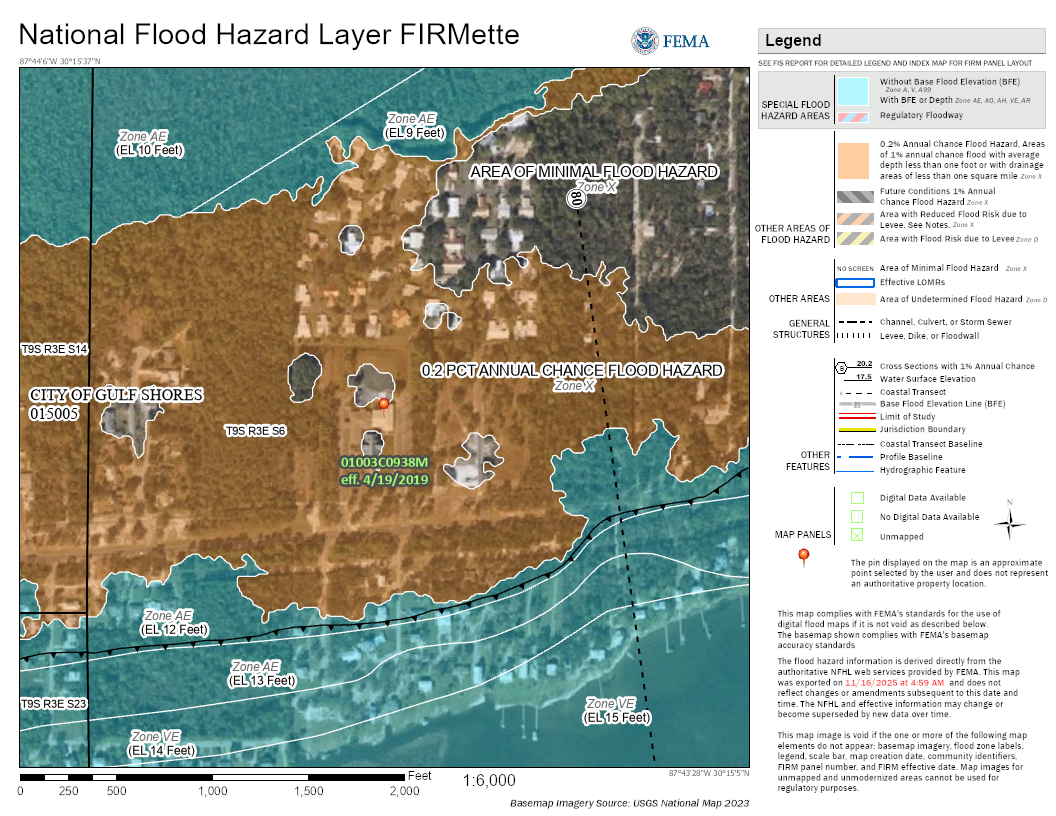
15.10 Wind Hazard Map (ASCE)
The wind map below is taken from the ASCE Hazard Tool for the property located at 17263 Fort Morgan Road, Gulf Shores, Alabama. It shows the mapped wind-speed contours and the hurricane-zone boundary as reported by the tool.
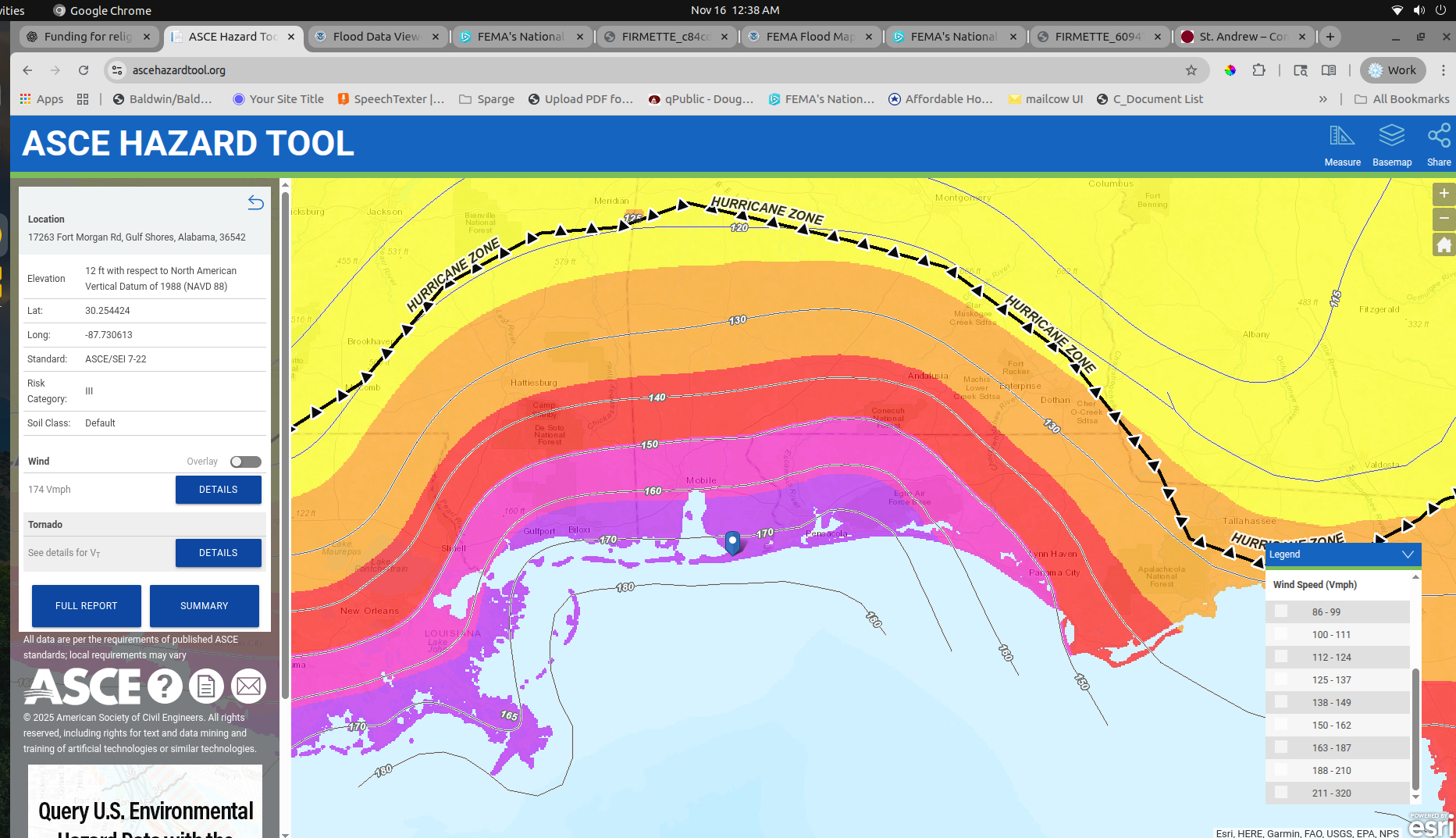
15.11 North Star Group – Services & Capabilities
North Star Group provides a set of services that help organizations understand their building, assemble clear information, and organize materials for use with engineers, county offices, and funding programs. The work is structured so each phase can stand alone or be combined with others depending on what the organization finds useful.
Early Discovery
This stage focuses on understanding the basics before any commitments are made. It includes reviewing drawings already on hand, examining publicly available hazard data, looking at the general facility layout, identifying which elements may matter most, and assembling preliminary information packets that licensed professionals often request at the beginning of their work.
Planning Document Development
Planning documents translate observations and hazard information into organized summaries. These may include room-use concepts, circulation considerations, operational notes, placeholder materials for emergency planning, and early descriptions of how different parts of the building might function during an activation. The intent is to create a clear reference set that can be expanded as needed.
County Coordination Support
Many counties prefer information in familiar formats. North Star prepares the packets commonly used in emergency-management settings, aligns materials with the structure that counties typically encounter, and organizes follow-up items when local offices request clarification or additional documentation.
Engineering Integration Assistance
Licensed engineers often require specific inputs to complete their evaluations. North Star structures these inputs, gathers supporting material, and prepares defined scopes so engineering time is directed toward the items that matter. This approach helps keep professional workloads focused and reduces unnecessary re-work later in the process.
Funding and Grant Strategy
When funding is of interest, North Star assembles eligibility notes, prepares narratives, organizes attachments, and develops budget summaries used in public, private, or philanthropic applications. The work emphasizes alignment between the proposed scope and the structure of the funding program.
AIA Contract Documentation
For groups that want to use standard construction contracts, North Star prepares the relevant AIA forms, communication documents, bid instructions, payment- application materials, and related items. These documents help keep contracting processes predictable and aligned with widely recognized industry standards.
Procurement and Vendor Support
North Star maintains relationships with several vetted vendors and can assist with obtaining comparable proposals, reviewing product options, and organizing procurement steps. This includes work with glazing, doors, hardware, and other items often associated with refuge-related improvements. Organizations may also use their own vendors, and support can be provided either way.
Fee-Paid Developer Services
Some organizations prefer broader coordination. North Star can act as a fee-paid developer by helping integrate schedules, contractor activities, engineering reviews, procurement steps, and required documentation. This approach keeps the work consolidated while maintaining a clear line of communication with leadership.
Implementation Support
Once funding decisions are made and professional recommendations are available, North Star helps transition from planning materials to coordinated work. This may include organizing installation steps, maintaining updated documents, preparing revised summaries, and structuring information for long-term reference so institutional memory is preserved over time.
15.12 Project Schedule Overview
The project schedule below summarizes the sequence of assessment, planning, coordination, and documentation activities. It reflects the anticipated pace of work across technical tasks, leadership reviews, engineering alignment, county coordination, and grant development efforts.